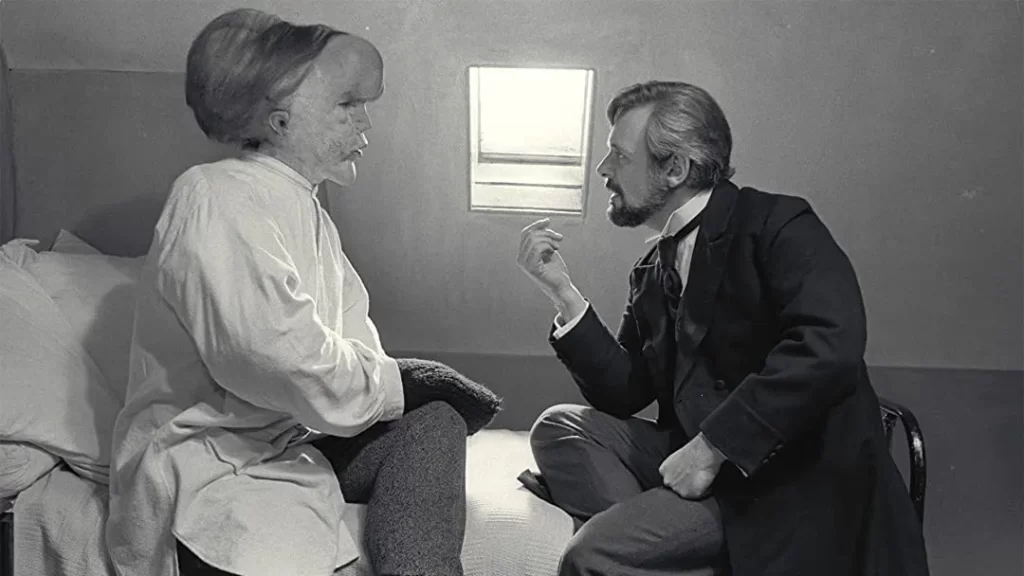
Dr. Frederick Treves is not a warm fellow. He is a proper Victorian man, after all, and a scientist to boot. His interest in the horribly deformed John Merrick is purely professional. He wants to house him at his hospital so he can study him, and he must convince the equally stoic head of the hospital that Merrick is worth more than an animal. So he trains the barely-speaking John to recite the first few lines of the 23rd Psalm. The administrator is not impressed, not until Merrick recites the whole psalm from memory. “It’s my favorite,” he adds in his tortured voice. “The Elephant Man” can speak, he can read, and he can pray. That discovery is crucial because it demonstrates Merrick’s humanity. But a person’s humanity is not the sum of his intellectual abilities. As Treves and everyone else will learn, Merrick is human because God made him—he bears His image, and so his life is worth living.
Anthony Hopkins is perfect as Treves, playing him as reserved and yet welling with an undemonstrative curiosity. I was reminded of what I consider his best performance—as butler Stevens in Remains of the Day. John Hurt is equally impressive as Merrick. His grotesqueness at first seems to mask his humanity, but as the movie progresses it’s as if his deformity becomes his humanity. Or maybe his malformations are simply the shape of it, and we are to learn humanity takes many shapes, just as it takes different colors and languages. Treves invites Merrick to his house for tea, and his wife Ann, far from repulsed, welcomes him to her table. She listens with rapt sympathy to Merrick’s adoration of his mother. Soon, celebrity actress Madge Kendal (a real person played here by Anne Bancroft) pays him a visit. We suspect her of some ulterior motive—surely she’s doing it for the likes. If that’s the case, any motives soon melt away amidst Merrick’s admiring friendship. Madge even gives Merrick his first kiss. No one, not Merrick certainly, thinks this will blossom into a romance. But being seen, respected, and treated as a friend is more than he’s ever had.
Not everyone is so kind. Wishing to emulate Madge’s generosity, other society members invite Merrick to tea and are unable to hide their revulsion at his appearance. Treves is justifiably disdainful of their Victorian virtue signaling. A hospital porter charges money for pub patrons to “visit” Merrick in his room, abusing him as they please. During one of these “sideshows,” Merrick’s old “owner” kidnaps him and whisks him off to the Continent to resume his life as a circus freak. But Merrick has now seen life as a man, and life as a zoo animal almost kills him.
The Elephant Man was David Lynch’s second feature after the experimental Eraserhead, and his strongest straight-ahead narrative. The surrealist filmmaker (a Transcendental Meditation devotee) brought his fascination with the bizarre to its most fruitful realization with this movie, beautifully shot in stark black and white. We enter the world of the film looking for monsters and come out of it invested in the beautiful humanity of its title character. Even though I’m a fan of Lynch’s work, I hadn’t seen The Elephant Man until recently. In it, we see the people we least expect—uptight Victorians, snobby aristocrats, and churchy religious types—demonstrating the compassion and mercy we should know all people are capable of. But in 2026, in the age of critical theory, we are surprised. Aren’t these colonizers? Oppressors? To be sure, none of the characters are flawless. But the fallenness of humanity is most harshly illustrated by the lower classes of London. It is they who hound and harass Merrick, driving him to utter the famous declaration, “I am not an animal! I am a human being!”

Yes, they too—the alley drunks, the women-for-hire, the gutter urchins—are human beings, and the very crux of Merrick’s story is that we are all made in God’s image. In real life, Treves was even more devoutly Christian than shown in the movie. Merrick also meditated on Christ day and night. (In the film, he builds a model of a cathedral he sees from his window.) How could he not? Without beauty, status, or riches, it was solely because he was God’s creature that he had worth. The Christian mercy of Dr. Treves, Ann, and hospital matron Mothershead, who overcomes her revulsion to love and even physically defend Merrick, is expressed in Victorian terms. We don’t get treacly music or pop songs with on-the-nose lyrics. Instead, The Elephant Man delivers its treatise—that we are all the imago Dei—in intellectual terms. Yes, Merrick’s appearance is monstrous. But only beasts judge on looks alone. The human being walks by faith and not by sight.
Not that The Elephant Man isn’t moving. I would even argue its pathos is enhanced by its reservedness. There is no spoon-feeding here, and I think there’s more value to that. By the end, when Merrick dies with Tennyson’s poetry and visions of his mother before him, there can be no argument that he is anything but a human being. Only men can feel such longing. Only those of us made in God’s image are able to overcome such suffering.
