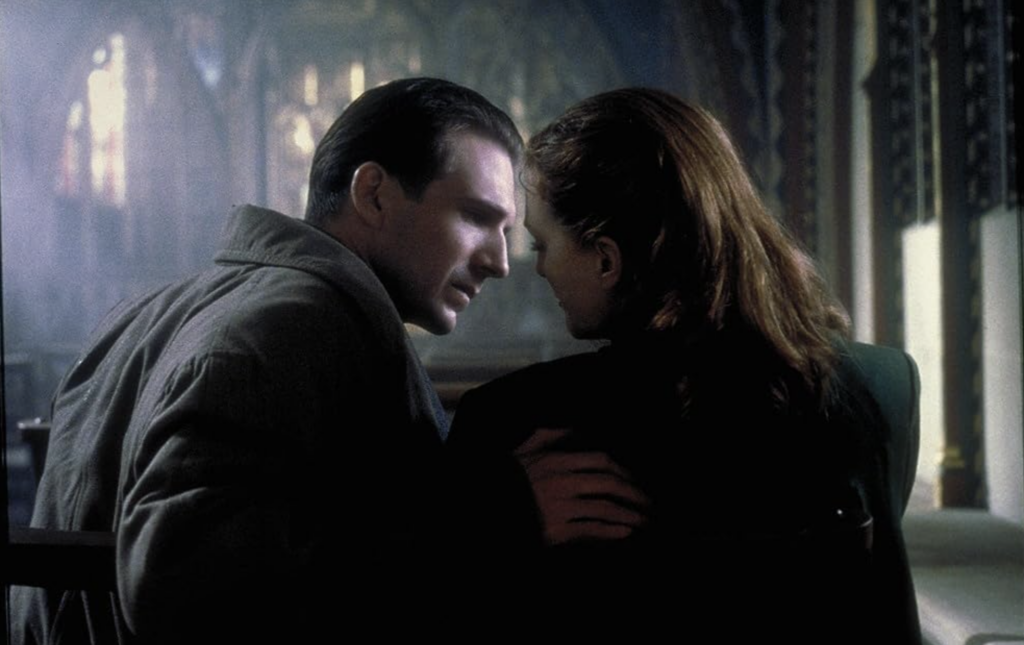
Graham Greene’s novel of The End of the Affair is one of my favorites, and Neil Jordan’s film adaptation is, in my opinion, the best of a filmmaker who’s directed some classics (Mona Lisa, The Crying Game) and some works better forgotten (such as In Dreams, once again proving 98% of serial killer movies suck). Jordan has publicly professed atheism, and Graham Greene, while baptized into the Catholic Church, always maintained an agnostic stance. Greene wasn’t a particularly good Catholic—he carried on a long public affair, which no doubt infused his book with its sense of reality and inner turmoil.
How then did these two God-skeptics produce what may be the truest film about God and faith in Him ever made?
Maybe the secret is to start with what God is not.
If God is love, then hate is God’s opposite. To hate is to be the anti-God. This is what the main character Maurice Bendrix is, the embodiment of hate. He says as much as he narrates the film, which begins with him encountering his friend Henry Miles. Years earlier, Henry’s wife Sarah carried on a hotly-burning affair with Maurice before she disappeared from his life. Bendrix never found out why, just as Henry never knew about Sarah’s affair. Now it seems Sarah has another secret lover. This knowledge drives Bendrix mad with jealousy.
How can anyone love Bendrix as passionately as Sarah Miles did? He is disagreeable, acid, and selfish. But he is played by the gloriously beautiful Ralph Fiennes, and pairing him with the equally desirous Julianne Moore adds a carnal worldliness to their relationship. After a romp in Maurice’s flat, the building is half-flattened by a buzz bomb. Finding himself miraculously alive, Bendrix pulls himself out of the rubble to find Sarah on her knees in prayer. She is stunned to see him alive and hurries out. The self-possessed Maurice takes this as a slight.
What he doesn’t know is the blast convicted Sarah of her sin. She had just prayed to God to save her lover’s life and vowed to end her affair if God did so. In the present, it is revealed Sarah has been seeing not a lover but a priest. She struggles daily with her vow and her adulterous feelings. The film and book are riddled with miracles and questions. In the end, the atheist Bendrix acknowledges God in his own way, ending with one of the best written lines in English literature.
I mentioned The End of the Affair is one the truest films made about God and faith. It’s also one that received an 18 certificate in the UK and almost got an NC-17 in the US for its steamy sex scenes. Christians may argue such a prurient movie can serve no godly purpose, but I’m fairly sure the filmmakers were not interested in making an affirming movie about the Christian walk. This is a movie packed with questions and skepticism. It is told from the point of view of an anti-God. Bendrix wells with hate and jealousy over Sarah’s husband and possible new lover. He hates Sarah when he thinks she’s rejected him. He hates God. Maurice Bendrix, despite his beautiful appearance, is a dark and tormented person, in contrast to the patient, long-suffering Henry (played perfectly and minimally by Stephen Rea) and the struggling Sarah. She is Jacob wrestling with God—falling, returning to Him, falling again, and finally succumbing to the Fall with a capital F. Sarah is all of us, looking for answers and confronted only with more sin, more hate, but also beautiful miracles.
I know Christians who question little. Perhaps they are blessed with the faith of a child, which Jesus urged us to have. The “Christian movie” is made for people such as these, who perhaps need only nudges of affirmation now and then. But for others, faith in God only opens the door to more questions. In this, faith is no different than science or journalism. These endeavors do not settle the matter—they raise new lines of inquiry, and the earnest scientist and reporter follows them with where they lead. In The End of the Affair, Henry hires a somewhat bumbling private investigator, played comically by Ian Hart. While we struggle like Sarah and rage like Maurice, God is dropping clues for even the most inept among us to find. It is for that audience—and the moviegoers who want to see a beautifully acted and crafted film—that The End of the Affair exists.
