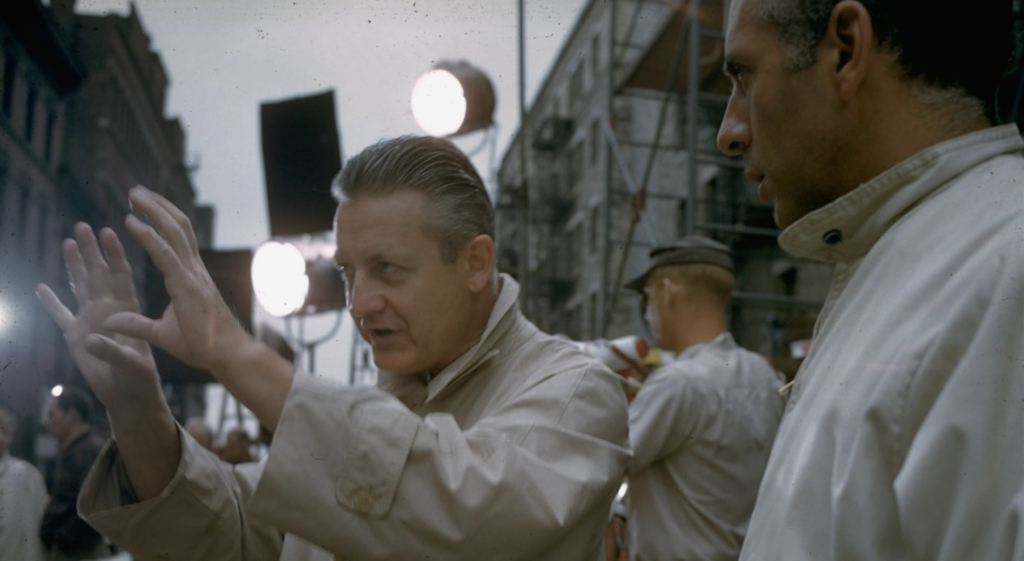
I met Robert Wise at Syracuse University, when he spoke to our small film production class and ran an editing workshop. What did this award-winning director have to teach us about editing? A lot—he edited a little film called Citizen Kane.
He also edited The Magnificent Ambersons, both Welles’ original vision and the studio-mandated recut. For that, several of my classmates called him a hack. His films don’t have a unified vision, one of them sniffed. It’s that sentiment that prompted this appreciation of “journeyman” directors. Because when you win two Academy Awards for directing, you’re far from a hack, unless you think John Ford, Frank Capra, and Steven Spielberg are hacks.
Let’s run through Wise’s oeuvre. After editing perhaps the most consequential work in the American filmography, he directed:
- The Day the Earth Stood Still
- Somebody Up There Likes Me
- Run Silent, Run Deep
- West Side Story
- The Haunting
- The Sound of Music
- The Sand Pebbles
- The Andromeda Strain
- Star Trek: The Motion Picture
Among many other movies both successful and not. Along the way, he won the Best Director Oscar for two of his musicals, West Side Story (shared with choreographer and co-director Jerome Robbins) and The Sound of Music. Both are classics and rightly enshrined in film canon. When he spoke to us, Wise recalled conceiving the revolutionary overture. Before West Side Story, overtures (if films had them) were played over a black screen or curtains. West Side Story gave us an abstract screen full of vertical lines, designed by Saul and Elaine Bass. At the close of the overture, they dissolved into the skyline of lower Manhattan. Wise also remembered the losing fight to shoot West Side Story on location in New York. The studio wouldn’t allow it. Wise’s solution: the stunning overhead aerial shots which lead into the opening Jets and Sharks numbers, both shot on location. These scenes create the sense of place that bleed into the backlot scenes.
(Having watched both West Side Story and The Sound of Music repeatedly on broadcast TV as a child, I have distinct but false memories of how the films opened. Both begin with aerial shots that transition into—dare I say it?—iconic moments. I remember West Side Story swooping down onto a close-up of the snapping fingers and The Sound of Music as a continuous helicopter shot ending with Maria turning around to face the camera. But no, both are hard cuts. They only feel like seamless transitions, much like Psycho’s opening shots feel like a drone is flying right into the hotel room. Wise’s experience as an editor no doubt helped craft these hall-of-fame opening sequences.)
So two large-scale musicals, some fantastic big-budget war epics, a good number of horror films, and some science fiction classics—The Day The Earth Stood Still gave us the immortal line Klaatu Barada Nikto, but I want to examine how Wise cultivated a spare and languid style for the other two. First, though, The Haunting.
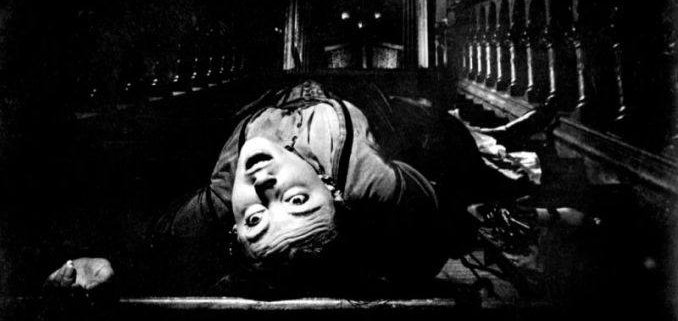
Based on a Shirley Jackson story and made into two films and a TV series, The Haunting follows a group of paranormal investigators studying a house with a deadly history. Wise recalled to us his aim was to conceal as much information from the audience as possible. Offscreen sounds of slamming doors and creaking floors unsettle all of us in the dead of night. His experience with optical printing (used extensively on Citizen Kane) led to action that moved at an unnatural pace, a technique also used in Murnau’s 1922 Nosferatu. Wide angle lenses distorted the image. Dutch angles and non-orthogonal production design keep us off balance. The Haunting is not so much about poltergeists as it is about madness and the disconnect from reality. It’s also about the unknown. As films like Jaws and Aliens would attest to years later, it’s what we don’t (or can’t) see that terrifies us more than what’s in our faces. The Haunting is a truly frightening movie that is implausibly rated G. While the MPAA rating system was not in effect at its 1963 release, subsequent video ratings pegged it as suitable for all audiences because there is no gore, no blood, no sex, no foul language, and only one instance of violence and death. It is not suitable for small children. Martin Scorsese called The Haunting “the scariest film of all time.”
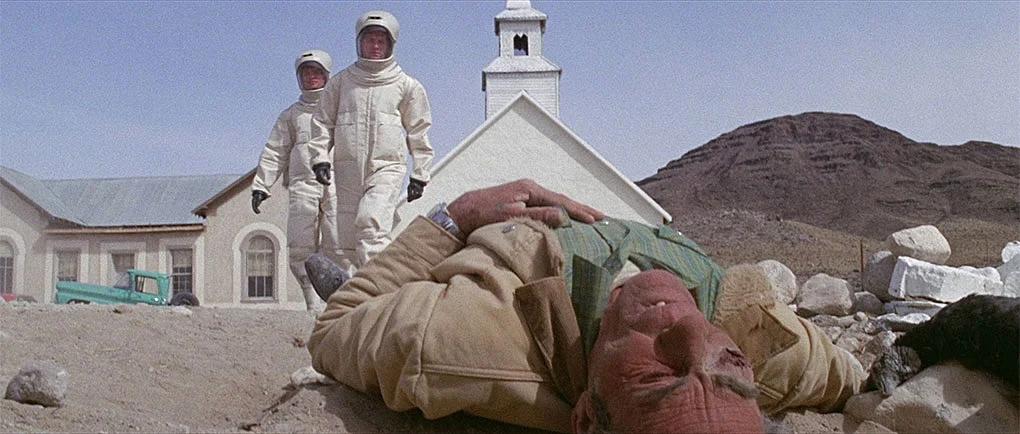
The Andromeda Strain was the first film adaptation of a Michael Crichton novel, and I think it’s a good one. Before his death, Michael Crichton was my guilty pleasure reading. His page-turners always included some science-y angle that assured you it was more than beach reading. (No, they were just beach books, but good ones.) But unlike Westworld or Jurassic Park, The Andromeda Strain proceeds at a measured and sterile pace. The acting is stilted and cold, as if Robert Bresson had directed the show. Yet it’s still thrilling because the stakes are so high. Experimentation with the minimal acting style championed by Bresson seemed to be in vogue in the late 1960s and early 1970s—Bergman, Kubrick, and Tarkovsky brought their arthouse sensibilities into the mainstream and even star-driven action films like Bullitt tried it on for size. The Andromeda Strain captured a scientifically accurate story with special effects from 2001’s effects master Douglas Trumbull. Its attention to detail makes this movie about an alien virus a more frightening film than The Stand or Contagion, even with—or maybe because—of its coldness.
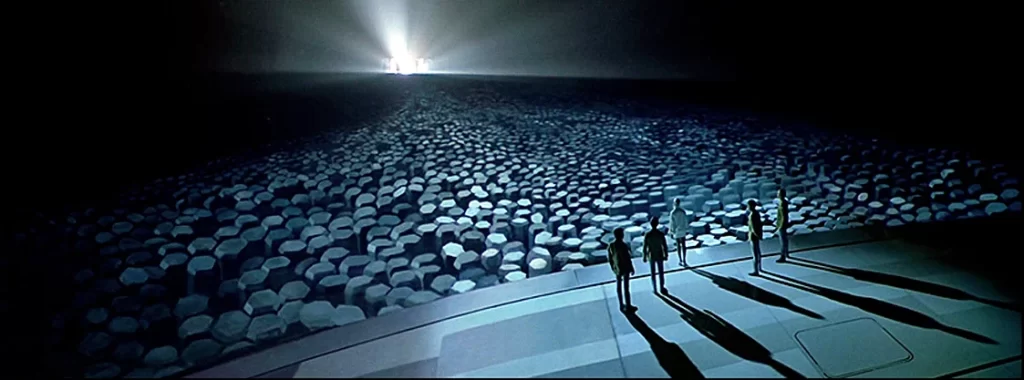
That coldness didn’t succeed as well in Star Trek: The Motion Picture. I love Star Trek, but like a lot of fans, I didn’t love the first cinema outing of the Enterprise. Like Andromeda Strain, it was cold, spare, and sterile. Some of this is due to the loopy Roddenberry story, which offered no villain and no human drama—only his goofball new-age ideas of humanity evolving to become one with the universe. In pieces, Star Trek is great. The visual effects (again, by Trumbull) are top-notch. The musical score is Jerry Goldsmith’s best and is forced to carry the film through the overly long (if beautiful) grace shots of the Enterprise leaving drydock, flying into the cloud, and so on—all at a very slow pace. Again, it’s as if Paramount had hired Andrei Tarkovsky to direct. It lacks the fun of Trek, the camaraderie, the adventure, the banter. (Only one laugh stands out: when Spock describes the malevolent V’ger as a child, McCoy gruffly responds, “This ‘child’ is about to wipe out every living thing on Earth. Now, what do you suggest we do? Spank it?”) Kirk, Spock, et al, don’t seem like themselves, but rather ultra-serious cardboard stand-ins. Nicholas Meyer would explore Kirk, Spock, and McCoy in greater depth as humans (or half-human, in Spock’s case) in Star Trek II, and the whole bridge crew as round and lovable people more in IV (which he wrote) and VI (which he wrote and directed). Meyer understood Trek. Wise, ever the accomplished director, may have been the wrong man for the job. Even the lighting doesn’t showcase the Enterprise as a shiny futuristic starcraft, but more like a high-tech office building.
After Star Trek, Robert Wise didn’t direct another movie for ten years—Rooftops would be his last. Like so many storied directors (Walter Hill, Bob Rafelson, and the aforementioned Welles), Wise’s career ended on a low note. Fortunately, Wise will always be recognized for his hits and his classics. He edited a revolutionary cinema landmark. He made two of the most beloved musical films in film history. He directed one of the most quotable sci fi movies ever. And he made the scariest G-rated film of all time.
