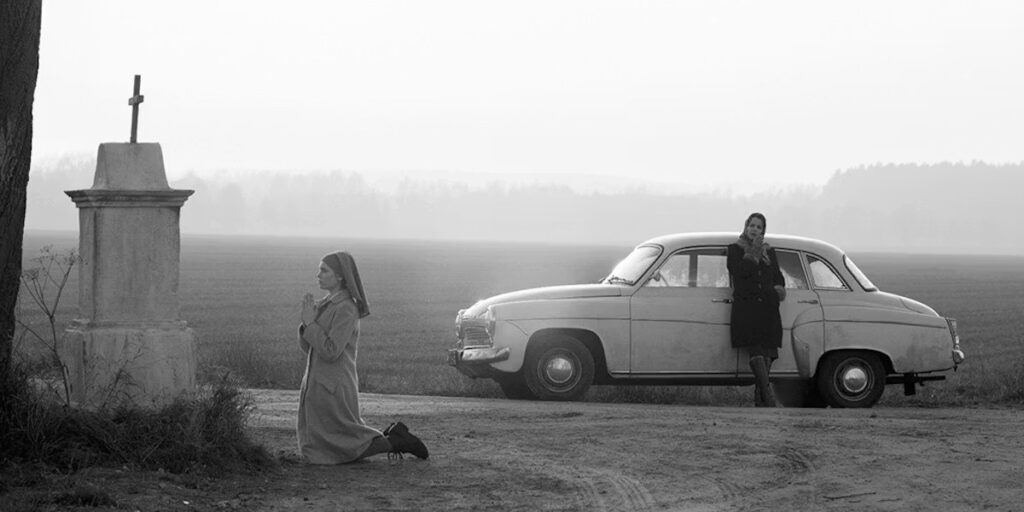
Anna is a puzzle, her emotions held close to her chest. And there must be a lot of emotion boiling under her simple novice’s habit. On the eve of taking her vows and entering the life of a Catholic nun, her prioress tells her she must visit the only family she has—an aunt she’s never met. Aunt Wanda tells her “Anna” is actually Ida Lebenstein, a Jew, the only member of her family who survived Nazism. Wanda, a communist party leader and former resistance fighter, urges the convent-raised girl to enjoy worldly pleasures—liquor, cigarettes, jazz, and Lis, a handsome itinerant saxophonist to whom they give a ride. The innocent Anna isn’t so sure. Wanda is rootless and dissolute. She is beautiful and sexy, but Ida and the audience sense a dissatisfaction in her. Instead, Ida wants to see her family’s old house. It’s now occupied by Polish Christians who rescued Ida from the Germans. Her mother, father, and brother—they’re another story.
The choice to film Ida in black and white was the correct one. The story takes place in 1960s Poland—not just in the past, but a grey Communist past. And for a film that begins in a convent and makes its way to the graves of the Holocaust, it seems like Ida intends to dip into a pool of black and white morality. Not so fast. This film is brutally honest about the role rank-and-file Poles played in the Holocaust. If you seek a film that elevates the Christian and diminishes the Communist in easy terms, this is not the film for you.
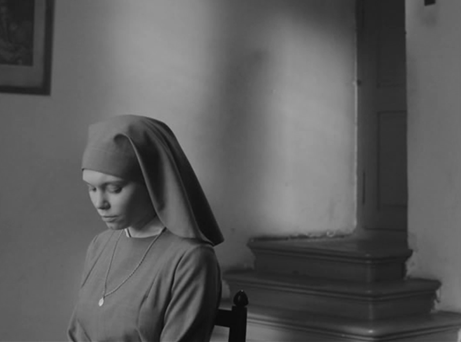
At a brisk 82 minutes, Ida is spare, minimal, and beautiful, with compositions that place Ida and other characters near the edges of the frame. The black-and-white images call to mind the minimalists Robert Bresson and Carl Theodore Dreyer (especially his evocative Passion of Joan of Arc). There are also hints of Andrei Tarkovsky. In addition to these three specifically Christian artists, I could also add the influences of the Marxist Jean-Luc Godard and the humanist François Truffaut, especially in a gorgeous locked-down long take, where the mise-en-scene and even the costume choices round out the narrative as much as the event portrayed on-screen. To Ida’s influences, I could also add the spirit of fellow Pole Krzysztof Kieślowski, who explored the enigma of identity in The Double Life of Veronique and Christian ideas in movies many modern American Christians would avoid. The morality of his Dekalog is not clean. But like the fallen people of the Bible, that movie series and Ida portray what God made us to seek: the truth.
Ida speaks the truth, and the truth pulling Ida in different directions is both achingly simple and dramatically satisfying. Paweł Pawlikowski’s film is about identity. The Christian (indeed all of us) want to know who we are, what God made us to do. Ida/Anna has lived her entire life expecting to take her vows as a nun, only to be thrown this curve by her Mother Superior, who knows it would be dishonest to hide the truth from Ida. She also understands Ida needs to discover the truth for herself, and in the process wrestle with her identity. If she returns to take her vows, she does so with eyes wide open. Unlike American Christian films, there is no “side” to cheer for. There is only Ida. Because God fearfully and wonderfully made her as an individual: Ida Lebenstein, woman, novice, and one of God’s chosen people.

How should we think of Ida, a movie that has much to say about the Christian life, in relation to the Jew? The right person to ask would be the director and co-writer Paweł Pawlikowski. In his teens, he learned his grandmother was a Jew. She died in Auschwitz. Pawlikowski is a Polish Catholic with Jewish roots, not too different from Christianity itself. Ida’s co-producer Eric Abrahams pushed back on the homegrown criticism of Ida’s muted Jewishness and the role of Poles in the Holocaust, as well as stereotypes of Jews as Communists (as in the case of Wanda). Everyone knows what happened, he griped. This is a film about Ida Lebenstein/Anna and Wanda Gruz, not the Polish Jew or the Polish Christian.
And there is my biggest contention with the simplistic American Christian movie. In it, all Christians must be redeemable and all atheists reprehensible. People are reduced to types, in contravention to God’s design for us. Ida‘s denouement and the path to it will not satisfy Kirk Cameron. Likewise, it is perhaps maddening to the Jewish viewer, who could interpret Ida’s journey as another chapter in the Holocaust’s relentless erasure of Judaism. But it is honest—not only in portraying the struggle for identity that affixes the real Christian youth, but it’s also honest for the young woman who begins the story as Anna and continues into the future as Ida Lebenstein. In the open-ended final minutes of the film, Ida is affirming of Christianity and damning of the atheistic, dissipated alternative of Communism. In this, the Polish filmmakers set before modern day Poland life and death, blessing and curse. I believe Pawlikowski wants his countrymen—indeed all believers— to therefore choose life, that we and our offspring may live.
