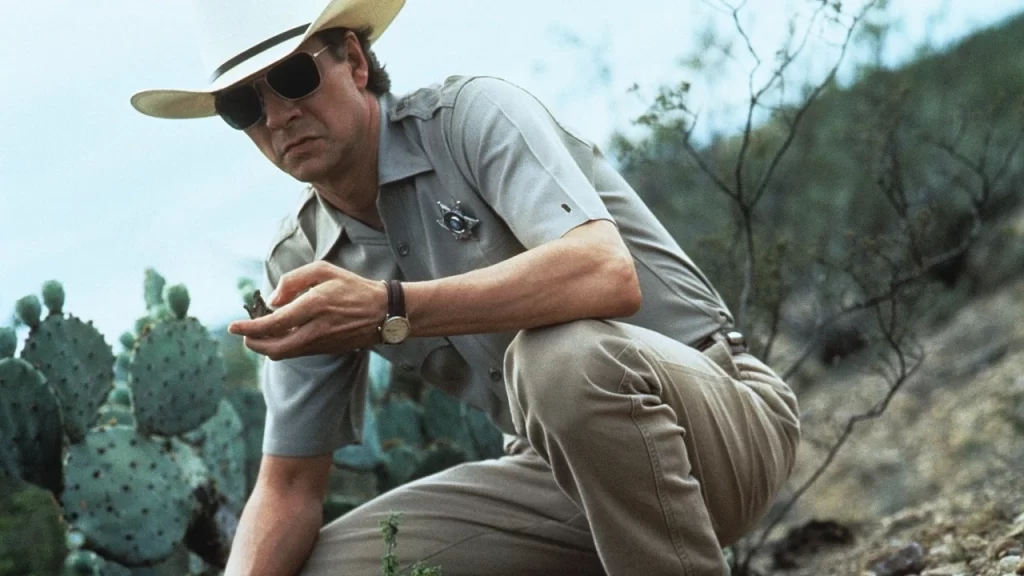
Lone Star is the Great American Movie.
Oh, I know I nominated a number of films for this title (It’s a Wonderful Life, Sullivan’s Travels, The Man Who Shot Liberty Valance, Citizen Kane, Ben Hur, Oppenheimer, October Sky, Malcolm X, Daughters of the Dust, and Once Upon a Time…When We Were Colored—and believe me, there are more), but if I had the task of naming one film to represent the United States of America in a world movie Olympics, it would be John Sayles’ Lone Star.
What film better encapsulates the unique ethnic and cultural diversity of America? Where other nations rely on a religious or genetic identity to unite its population, the USA has always been a hodgepodge of diverse peoples coexisting under the Stars and Stripes. Theodore Roosevelt summed it up for posterity when he referred to America not as a place but an idea.
The story deftly weaves Anglo, Latino, Indian, and Black stories in and out of one another, hooking you in with a genre convention—the murder mystery. The film starts with the discovery of a skeleton bearing a Masonic ring and a badge. This is the long-disappeared Charlie Wade, the hated former sheriff of border town Frontera, Texas. Wade was a murderer and extortionist, presumably killed by his deputy Buddy Deeds. Complicating the investigation is the identity of the current sheriff, Sam Deeds. As Buddy’s son, will he follow the trail where it leads, even tarnishing the good name of his beloved father?
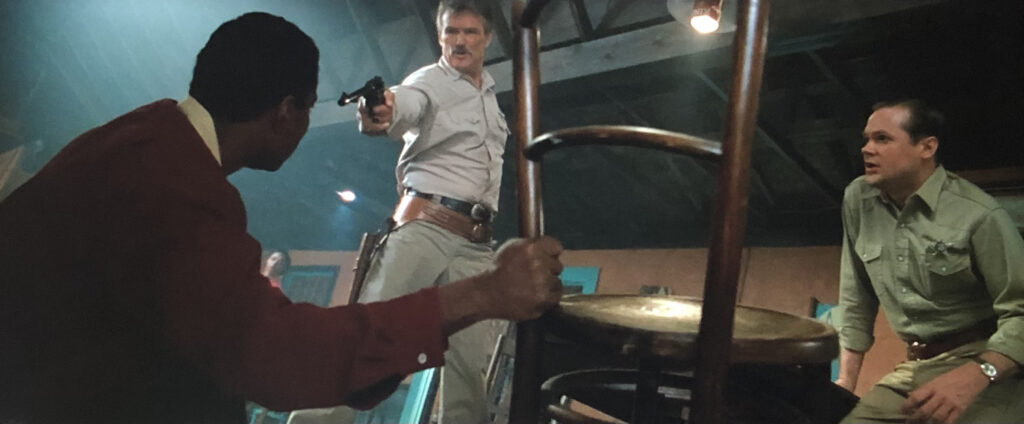
To be sure, Sam was not one of his father’s admirers. The elder Deeds worked hard to keep young Sam away from his teenage crush Pilar Cruz. Was he a racist like Wade or was there another reason to disapprove of their love? Throw into the mix a new commander at the local army base. Colonel Delmore Payne (Joe Morton) also has roots in Frontera—his estranged father Otis runs the only bar in town where, according to him, black people are welcome.
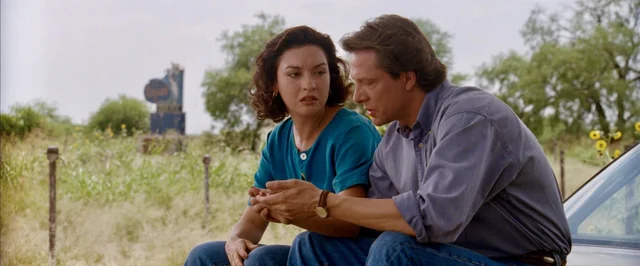
Lone Star is not just a movie about Texas. It’s a story about America and the lively, messy mélange that forms our national identity. Transplant the story to New York, Boston, Minnesota, or California at various times in history, and all you’d have to do is change the family names. But Lone Star works because it’s specifically about ethnic tensions in late twentieth century Texas—tensions everyone in the USA would know. Early in the film, a school board meeting erupts into an argument about “whose history” the schools should teach. Are Davy Crockett and Sam Houston the heroes of The Alamo or should it be Santa Anna? When someone accuses a white parent of racism, she shoots back that she’s all in favor of Mexican food and music.
The answer Sayles provides to “whose history?” is simple: you cannot disentangle white American history from Latino American history from black American history. The story of Wade’s death ropes everyone in. Sheriff Sam soon discovers Otis, Pilar’s parents, his own father, and the current Anglo mayor all had roles to play. It’s a brilliant script which never lags and lopes from one development to the next—in both the past story and the present. In fact, Sayles moves from present to past without scene transitions. The camera dollies in to a stack of tortillas in the present day, then dollies out to reveal we’re back in 1957. It seems we’re not just connected one to another, but also to our past and our parents. As the mystery hurtles to its revelation, that connection becomes even clearer.
John Sayles, a writer-director known for large casts and sprawling stories of a place and time, is at his pinnacle here, coming off successfully crafted indies like Eight Men Out, City of Hope, and The Secret of Roan Inish. Lone Star is also an independent production, which also recommends it as the Great American Movie—we are, after all, a nation of independent cusses. There are no big stars—Chris Cooper as Sam and Matthew McConaughey as Buddy were not yet the leading men they would become. Kris Kristofferson, playing Charlie Wade, was the biggest name by far. But Lone Star doesn’t rely on star power. It relies on the familiarity we all share as Americans—the wary but necessary symbiosis we have with other ethnic groups and also the conflict we observe between parents and children. A crafty moment in this bilingual film: after a tense argument between Pilar and her mother Mercedes, a female cook speaks unsubtitled Spanish to Pilar. She responds in weary Spanish, also untranslated. The theatre I was in erupted in laughter, even though no one there understood the words. Mother-daughter conflict, it seems, needs no translation.
The best way to make an “issue film” is to hook us with a great story. Did Sayles set out to make some point about multiculturalism? As a socialist and the man behind the pro-union Matewan, it is possible. But Sayles is also someone intensely invested in our interconnectedness. He’s also one of the best writers working in movies (and novels). I love Lone Star because of the picture it paints of modern America, one struggling with language barriers and immigration. But more than that, I relish how Sayles placed these “issues” in the context of a detective story and a romance. To find itself, America must solve the murder and make real the love we have for one another—love that transcends race, language, and, at least in this film, even family complications.
This is the thirteenth and final entry in The 1990s: 13 Movies. Germany, Australia, Japan, Senegal, Taiwan, and Denmark were all represented, and right now I’m remembering standout films from Mexico, China, Burkina Faso, Argentina, Iran, France, and many other nations. But it’s no surprise that this movie occupies an outsized space in my cinema memory. I’m American, the movie industry is American, and Lone Star exemplifies the scars, the promise, and every good hope we have of coming together as Americans. Sayles closes the film with a simple line that flies in the face of Lone Star’s obsession with memory and the past: “Forget the Alamo.” For the people of Frontera, Texas, that’s good advice.
