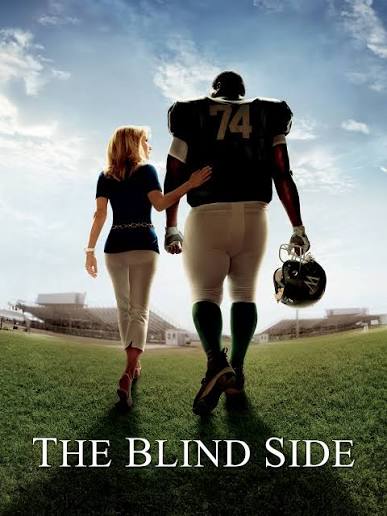
The Blind Side is a Christian film made by Hollywood. It is not the only such movie (see Amazing Grace, Hacksaw Ridge, Little Boy, The 15:17 to Paris, all the Narnia movies), but it is the only one in recent memory that won the lead an Academy Award. That it has its extremely vocal detractors is not surprising. Any film that deals with the Christian life so positively is due for a lashing. That The Blind Side is a true story almost makes it worse for its critics. They don’t like that black men like Michael Oher lived in poverty. They certainly don’t like that wealthy families like the Tuohys exist in such comfort and happiness. And I suspect they really despise that such people profess Christ and extend their hands in mercy. This goes against the notion that Christians are hypocrites and self-centered. If non-believing critics hate The Blind Side, well that just makes it even more successful of a “Christian movie.”
But let’s dispense with all that and talk about the actual movie.
The film opens with Wingate Christian School’s coach exhorting the board to keep student Oher on despite poor grades. He points to the school name here, saying:
“Look at the wall. ‘Christian!’ We either take that seriously or we paint over it. You don’t admit Michael Oher because of sports. You admit him because it’s the right thing to do.”
You could ask if Coach Cotton would say this about a kid who was not an asset to his team. And why is it the right thing to do? These are serious questions that are sadly glossed over here. Are we supposed to accept that Wingate admits all poor applicants, even those who don’t meet academic standards?
Anyhow, the Tuohy family sees Michael shivering in the cold one night and invite him to stay the night in their home. This is no ordinary house. The Tuohys are wealthy. Leigh Ann (an Oscar-winning performance by Sandra Bullock) is a headstrong evangelical Christian. Privileged, yes. Compassionate, yes again. The two exist side by side. The more Leigh Ann learns about Michael, the more determined she becomes to help him. She hires a tutor (Kathy Bates) to improve Michael’s academic performance. Only once his grades are up can he get onto the gridiron where his natural abilities shine. From there, it’s on to college, then the NFL.

Christian films are often called “inspirational,” and The Blind Side is certainly that. It’s a triumph of grit and compassion over adversity. But it’s far from a problem-free movie. Leigh Ann begins as a kind of perfect Southern aristocratic stay-at-home mom and finishes the same way. I have no objection to this character—I know many women like her, and yes, they do always get their way! I also have no objection to wealthy upper-class people portrayed as positive agents for change—one, because I’m not a Marxist, and two, this is based on a true story. (Last month’s entry, The Elephant Man, also depicts well-off Christians using their privilege to help a downtrodden man.) However, I would have liked to see some transformation in her character. Leigh Ann Tuohy is always right. We are supposed to accept her ideas are always right, even when they seem tinged with ulterior motives. Even the gang-bangers she confronts submit to her.
It’s that presentation of perfection that I think bothered the film’s critics. Does The Blind Side propose Christianity is what makes people like Leigh Ann Tuohy perfect, untroubled, and without blemish? This movie doesn’t, but I have encountered a sort of prosperity-adjacent idea among some evangelicals that the right-thinking Christian should be materially rich and healthy—and thus their opinions are of course correct. The children should, like the Tuohy kids, behave docilely. In some people’s minds, perhaps Leigh Ann is a bully, even cajoling Michael to play football for Ole Miss, husband Sean’s alma mater. But Leigh Ann Tuohy thinks she’s right because she’s just so darn confident. In other situations, this might be a flaw. In this story, it’s only because of her self-assurance that she dare appoint herself mother to Michael.
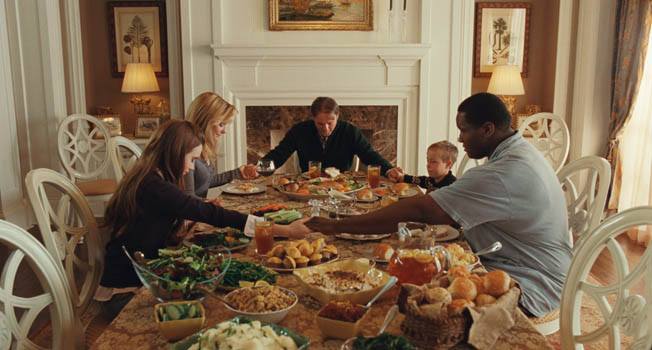
The movie focuses on Leigh Ann, but I think we’re missing a fuller story in Michael Oher and his mother Denise. In a wrenching scene, Leigh Ann presents Denise with a document. If she signs it, she gives up her parental rights, paving the way for Leigh Ann to adopt Michael. Typing this out, it sounds awful, stealing a child from his mother. However, Adriane Lenox plays Denise as a realist. Addicted to crack and unable to care for Michael, she signs, the weight of it visibly crushing her in the scene. Other flashbacks show Michael’s hardscrabble upbringing. Some critics disdained these as stereotypical of black Americans, a criticism never leveled at the harsher depictions of urban life in Boyz N The Hood. Michael, played convincingly on every level by Quinton Aaron, has more struggle, more gain, and more dimension. Michael shows how Christ lifts us out of the muck. Leigh Ann says out loud that her relationship with Michael changes her. But you know what they say about show, don’t tell. Still, I think Bullock pulled off something crafty and brilliant here. She played a real person, a real type, and one that makes us uncomfortable because Leigh Ann Tuohy is evidence life is unfair. And Bullock made her sympathetic, someone to root for. Clearly the Academy agreed.
Writer-director John Lee Hancock is a rare professing Christian in Hollywood. The real Leigh Ann Tuohy is also outspoken about her faith—Sandra Bullock almost never removes her diamond cross pendant in the film. In a way, The Blind Side both suffers and benefits from these externalities. They mark it as a “Christian film.” Its inspirational story marks it as acceptable for the evangelical audience and its focus on Leigh Ann over Michael mark it as, if I may be so crass, a “white” film as opposed to a “black” film. These qualities energized its fans as well as its detractors, and it’s perhaps heartening that so many secular movie critics found something to love when the movie came out in 2009. After 2020, I doubt the movie could be made outside of Angel Studios.
The problems of race, privilege, and charity in The Blind Side should not be swept away. I wrote a separate essay on race in this film because I felt it needed more space. In the end, though, I do not question the Tuohy’s Christian charity. Leigh Ann’s expression of it may come off as overbearing, but that doesn’t make it wrong. Would we rather she left Michael to freeze out in the rain? I think Jesus had something to say about that.
