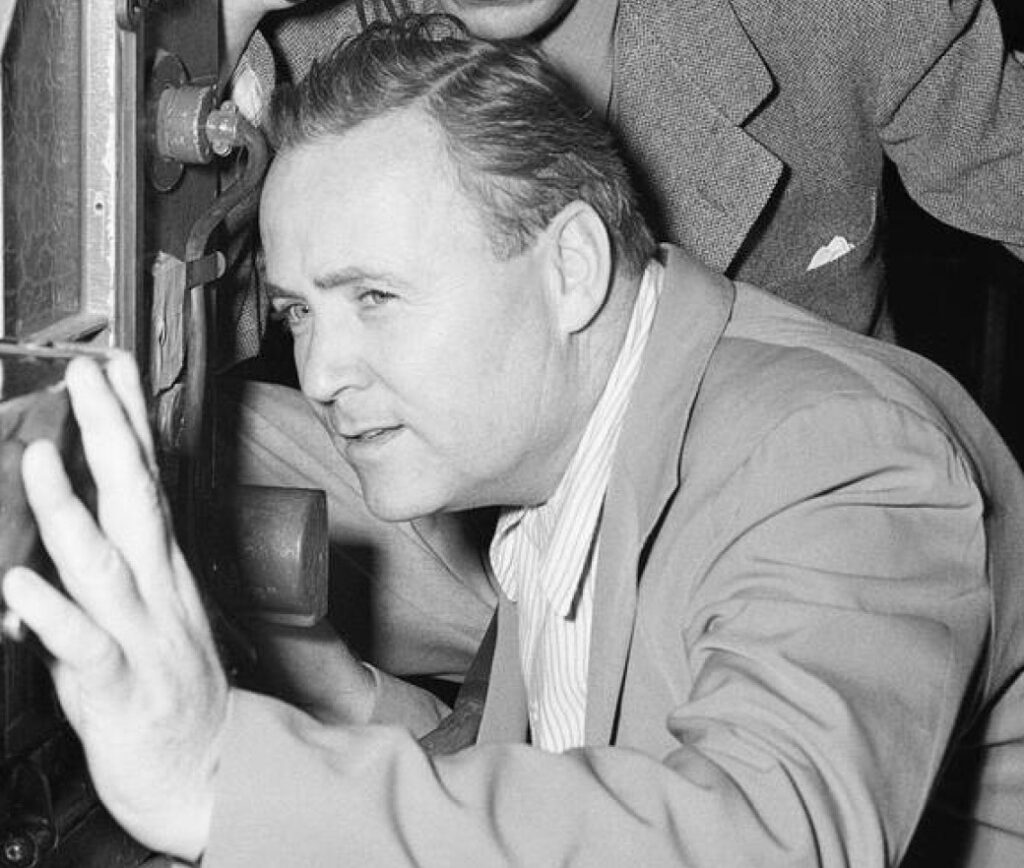
I haven’t seen many of Henry Hathaway’s movies, but I’m including him because he directed one of my favorite noir films ever: Kiss of Death (the 1947 original, not the David Caruso remake), in addition to an exemplar of the intrepid newsman genre, Call Northside 777. Oh, he also directed the lauded adventure The Lives of a Bengal Lancer and a passel of westerns, including the John Wayne classics The Sons of Katie Elder and True Grit.
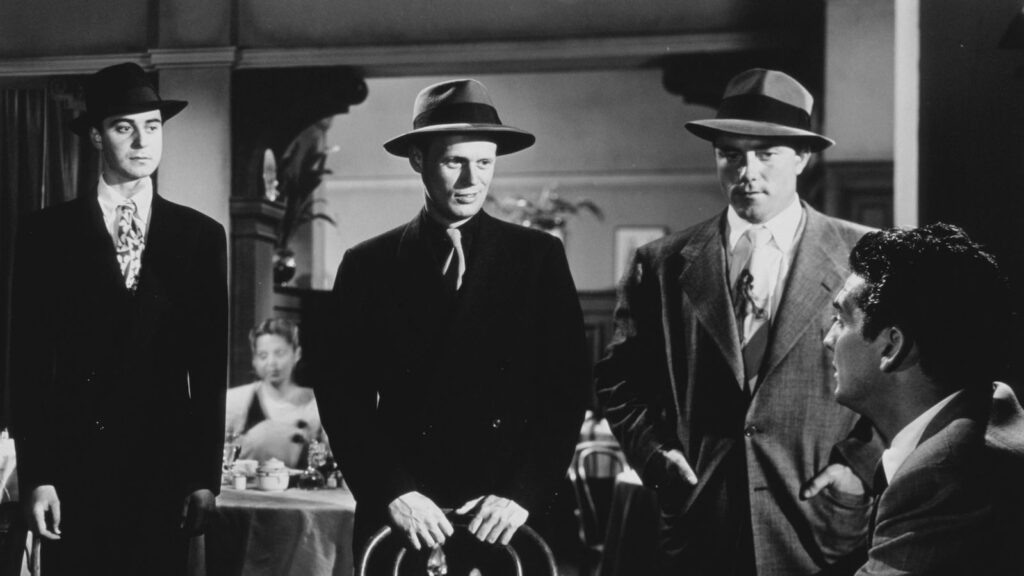
Kiss of Death features a tense, twisty story that begins with a jewelry heist. It’s quick, efficient, and conducted in near silence. Nick Bianco, the head thief played by Victor Mature doesn’t get away, and here is the first intrusion by a voiceover—one from a character we won’t meet until twenty minutes into the film.
Nick does his time, trusting his criminal compatriots to look after his wife and two daughters. They don’t, and Mrs. Bianco kills herself. This embitters Nick, who starts working with D’Angelo, the DA. A series of setups leads to the famous scene where the criminally insane Udo (Richard Widmark in his first role) pushes an old wheelchair-bound woman down a flight of stairs. Eventually, Nick and Udo will have to come face to face, and the way the showdown materializes does not disappoint.
Kiss of Death has much in common with films like The Naked City, which came out the following year. Both films were shot on location in New York City. Both films featured shocking (for the time) bursts of violence. Both had unnecessary voiceover narrations. Kiss of Death’s narrator is Nettie Cavallo, Nick’s eventual love interest. Her bookend narrations serve one purpose only: to assure you Nick didn’t die after Udo shot him four times. The original grim ending didn’t test well, so the studio insisted on the voiceover. (Blade Runner, anyone?)
Kiss of Death’s script by golden age legends Ben Hecht and Charles Lederer lets Nick transform from cold-blooded felon to enthusiastic family man. Mature brings to the role an earnestness and hopefulness that went against hard-boiled films noirs like Scarface and White Heat. Widmark of course steals the show with his wide-eyed Nic Cage nuttiness, which is probably why they got Nic Cage to play the villain in the remake.
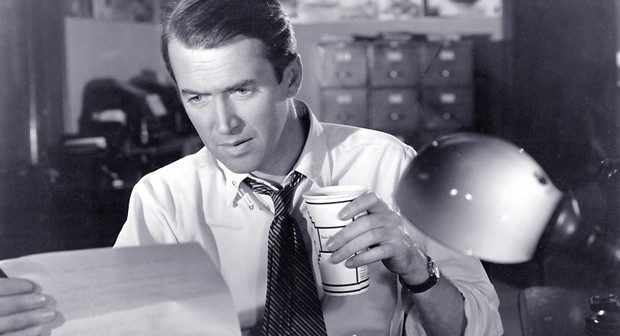
Hathaway directed Call Northside 777 the following year, continuing his experimentation with gritty realism, perhaps inspired by Italian films like Roberto Rosselini’s Rome, Open City and culminating in Jules Dassin’s The Naked City. Call Northside 777 was based on a real case, where a convicted murderer’s mother placed a newspaper ad offering a reward for exculpatory information. Like Jimmy Stewart’s P. J. McNeal, a real reporter followed the story through its surprising twists and turns, finally clearing the accused. In the movie version, a technological touch is added—one that did not occur in real life. To prove a witness lied, McNeal has a photo enlarged and then wired over to him. Wirephotos, essentially the same technology as a fax machine, had just entered widespread service. When you think about it, that’s an unnecessary plot point. McNeal could have simply had the enlargement mailed to him. It’s not like there was a deadline or the convict’s life was in imminent jeopardy! Call Northside 777 was advertised as being the first movie shot on location in Chicago, endeavoring to use as many actual locations as possible, thus underlining the influences of documentary filmmaking and Italian neorealism.
Hathaway did not attempt his gritty style for his westerns. The most popular genre at the time, westerns were heroic, triumphant, and morally clear. Until the spaghetti westerns, that is. True Grit was a post-Sergio Leone effort that offered an aging John Wayne his best role since The Searchers. He and Glen Campbell were at their finest as Rooster Cogburn and LaBoeuf. The young Robert Duvall cut Ned Pepper from the same psycho cloth as Widmark’s Udo. But I will admit Kim Darby as Mattie Ross came off as too light and cute. This is why the Jeff Bridges-Hailee Steinfeld version is one of the rare remakes that bests the original. In that version, directed by Joel and Ethan Coen, it’s clear Mattie is the one with grit. In Hathaway’s movie, the grit and the show belong to John Wayne. He won his only Oscar for this role. It has one of the top three western gunfights in movie history. When a killer cyborg copies your moves, you know you did something right.
Today, we often look at the studio system of Hathaway’s day as commercial and overly restrictive, prioritizing volume over art. Why shouldn’t it have? Before television, people went to the movies constantly. The appetite for big epics, B movies, low budget westerns, quickie detective films, and Saturday serials was immense. Moviemakers cranked out the films one after another and studios got the final cut. While that was happening, directors were racking up their 1,000 hours and getting regular paychecks—the same as actors, composers, camera operators, and everyone else. This wasn’t stifling. This was freedom. If you made three films a year, you could put your stamp on at least one of them. Maybe you wanted to try some gritty realism or shoot on location. The studio paid you either way.
Henry Hathaway got paid for making a lot of movies—classics, forgotten films, and everything in between. You do that many, and you’re bound to forge quite a few winners.
