Oliver Stone is a filmmaker who pours a lot of himself into his movies. Platoon described his experience as an infantry soldier in Vietnam. His persistent dance with drug addiction ended up on display in The Doors and his script for Midnight Express. His obsession with the paranoia and conspiracies is writ large in Snowden, Natural Born Killers, and JFK, a movie so bent on rewriting history it re-shot the Zapruder film to include a second assassin on the grassy knoll. Stone is a practicing Buddhist. So how does he make a triumphant movie featuring real heroes and a cameo from Jesus himself?
The answer, perhaps, is for all his faults, Oliver Stone is a filmmaker driven by truth. You can feel it in Born on the Fourth of July, Nixon, and even JFK, which centered on Kevin Costner’s Jim Garrison worming his way through the labyrinths of cover-ups. Unlike those films, World Trade Center features no conspiracies or shady dealings, only the straightforward heroism of very real characters. Actors play actual police officers, Marines, and family members who played their part on 9/11. The names have not been changed.
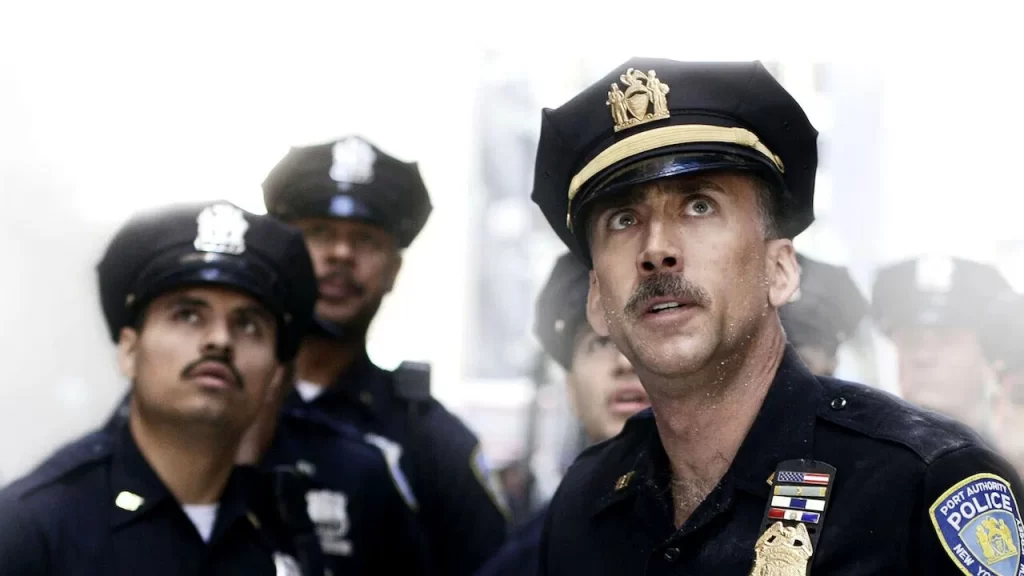
The screenplay by Andrea Berloff portrays the events with unadorned accuracy. Police officers rush into the World Trade Center after the first plane crashed into the North Tower. As the South Tower collapses, two of their number find themselves miraculously alive: Sergeant John McLoughlin (Nicolas Cage) and Officer Will Jimeno (Michael Peña). The comrades talk and keep one another’s spirits up, even as a slow death by dehydration and blood loss looms.
How would you describe these men? Even without Cage’s and Peña’s standout performances (they’re pinned by rubble for most of the movie), you would likely generalize these men as reliable, stalwart, good family men, maybe a little rough—salt of the earth New Yorkers. Most of us would also guess they’re churchgoing Christians. This is a character detail that almost never makes it into Hollywood movies. Characters can be Jewish. They can be culturally Catholic. They can be stereotypically evangelical if the story takes place in Texas. But very few movie characters exhibit a deep and authentic religious dimension. This is probably because most Hollywood filmmakers are non-religious. More of them have daily dealings with LGBTQ people or vegans than earnest Christians. When a majority of Americans profess Christ on some level, this is a tragic oversight. The denomination in which a character was raised informs his or her worldview. The inner life of a PCA Presbyterian differs from a UMC Methodist differs from a Primitive Baptist. Actors, writers, and directors should know these differences.
We get our confirmation of these men’s religious lives at a critical moment, when Jesus appears to Jimeno. He and McLoughlin debate what their Savior is trying to tell them. Is he encouraging them to persevere in tribulation or to “come home” to him? Two things that struck me about Stone’s realization of Jesus—one, he appears to Jimeno holding a plastic water bottle. Not a clay jar, but a modern Aquafina (or Dasani or Deer Park—I don’t think Jesus has an endorsement deal). This shows Christ as existing in the present. He is the Redeemer of the Now, the Lord of the Living. The other detail is how Stone films the vision. It’s brief and we never see Jesus’ face, obscured as it is by the surrounding brightness. This is the right choice, avoiding abstraction and a fixed conception of Jesus the man at the same time.
Jimeno’s vision follows McLoughlin’s reciting the Lord’s Prayer as his energy wanes. I’ve written about the paucity of prayer in movies, and this scene hits harder because right above him, retired Marine Dave Karnes is searching for him. As portrayed in the movie, Karnes, upon seeing the attack on the news, drives to his church and prays. Moved by the Holy Spirit, he travels from Connecticut to the fallen towers and joins the rescue effort. It is he and a brother Marine who find McLoughlin and Jimeno.
I was astounded at this forthright portrayal of a Christian man driven by God to do His work. Stone and the other filmmakers didn’t question Karnes or his motives. They played it the way he told the story. Michael Shannon, who has at other times played evil religious zealots, portrays Karnes straight up. One Slate writer didn’t understand his motivations. She wrote: “In the movie, many of Karnes’ lines are cryptic religious references that make him seem like a robotic soldier of Christ—a little wacky and simplistic.” Wacky, perhaps, to someone who’s never been convicted by God. (And was Karnes “robotic” or stoic like a proper Marine?)
Released in 2006, World Trade Center depicted an event that was still raw in our minds. Like United 93, which came out the same year, this movie gave us a triumphant story colored by immense sorrow and pain. Stone made another good decision to not show the planes smashing into the towers. We hear them. We see the effects. But this was not a Michael Bay movie. This was a movie about real people doing real, heroic things on September 11, 2001. That included praying, communing with Christ, and jumping into action because God told them to.
