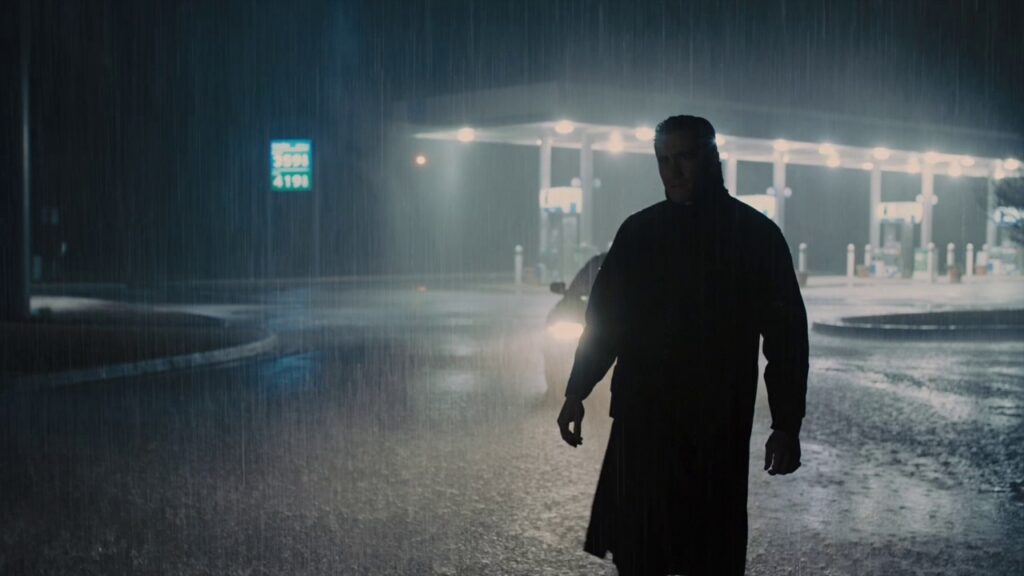
Everyone knows a story without conflict is no story. No one wants to watch a movie about a simple person’s happy and untroubled day. Why is that? Why is misery, agony, and anxiety the way of life? It all goes back to The Fall. The Christian outlook on our world begins with a perfect Creation that is almost immediately undone by an act of disobedience. In rejecting God and the Paradise He gave us, we brought on ourselves the misery, agony, and anxiety that populate our stories. Stories are the way we deal with this regret.
Which is why we yearn for stories of redemption. Jesus Christ achieved that for us, but for most of us—even the faithful Christian—we’re nagged by the sinful notion there must be more. Just as we can’t be satisfied with Eden, so it seems we’re not sure the Cross is redemption enough. Hence the relentless parade of movies, plays, books, and opera where people must earn their own redemption. And Christian characters are some of the worst offenders. Why does Father Karras have to throw himself out the window at the end of The Exorcist? Has not Jesus power over demons? Ye of little faith! (At least Arnold Schwarzenegger in End of Days was a cop who didn’t attend seminary.)
But not everyone wants that redemption. For the characters in Prisoners, pride, anger, and an unhealthy fixation on one’s own powers of self-reliance veil their eyes from the Cross. All of these characters are believers in the One True God. And in more ways than one, their pride and wrath consign them to Hell.
Prisoners, written by Aaron Guzikowski and introducing a talented French Canadian director named Denis Villeneuve to American audiences, opens with a recitation of the Lord’s Prayer, ironically punctuated with a rifle shot. Keller Dover (Hugh Jackman) is showing his son how to hunt deer. On the drive home, a cross hanging from the rear-view mirror, Keller lectures his son on how civilization rests on a paper-thin foundation. All of life is one hair’s breadth away from chaos. Keller is a prepper, a blue collar American comfortable with guns and church, but not with the world. He rightly sees evil, but like most of us he has a blind spot when it comes to his own sins.
The story kicks off on Thanksgiving. Neighbors Franklin and Nancy Birch (Terrence Howard and Viola Davis) join the Dovers (Maria Bello plays wife Grace—and no, there is no symbolism in her name) for dinner. The Dover and Birch daughters disappear. Suspicion falls on a mentally disabled man named Alex Jones (Paul Dano), but the police don’t believe Alex is capable of such a crime. However, Alex whispers something to Keller that indicates he’s the kidnapper, whipping Keller into a frenzy. He abducts Alex and imprisons him in an abandoned property he owns, torturing him into revealing the girls’ whereabouts. When the Birches find out, they are horrified, but Nancy sanctions Keller’s rage-filled persecution of Alex. Detective Loki (an inscrutable Jake Gyllenhaal) follows Keller, convinced he’s responsible for Alex’s disappearance. But he also follows up on other trails: a priest with a rotting corpse in his basement; Taylor, a disturbed man with a house full of snakes and mazes; and Alex’s aunt Holly (Melissa Leo), who has demons of her own.
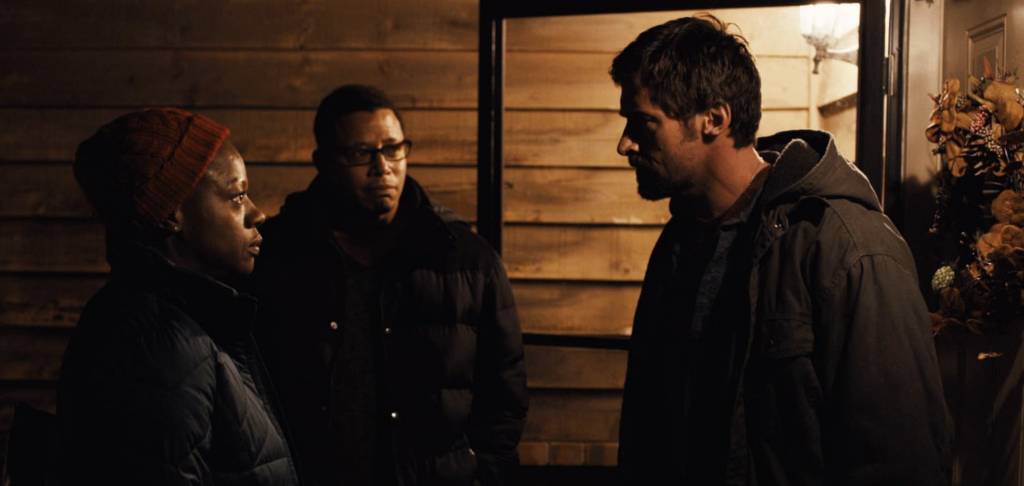
Everyone is a prisoner here, as it turns out. Although the Dovers are nominally Christian, it appears to be more of a cultural signpost than a conviction. We discover Alex, the priest, Taylor, and Holly all live in dungeons constructed in their minds by God. Holly and her husband have declared war on a Creator that stole their son away, and they used Alex and Taylor as pawns in their diabolical chess match against Jesus. The parallels between Holly and Keller are never obvious but they are there. Both begin their stories as believers. Now both are villains, meting out what they consider cosmic justice on an evil world. No matter that “’Vengeance is mine, and I will repay,’ says the Lord.” Both of them have denied the redemption of Christ and have taken the salvation of the world on their own shoulders.
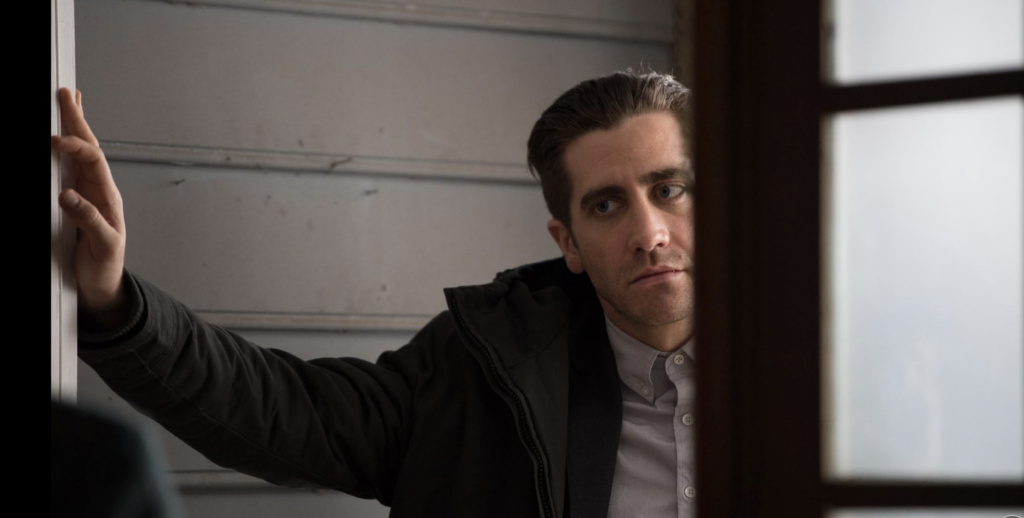
They key to understanding Prisoners this way is Detective Loki. His name is a clue that he’s not simply a character. He is the anti-God, or at least an alternative. Loki is a freemason, as evidenced by his ring. Oddly for a police officer, he bears tattoos with astrological or occultic symbols. Loki is not only a Norse god, he’s also a shapeshifter, a trickster, and most telling, the child of giants. In Prisoners, the agent of order is not Christ but the offspring of the Nephilim and Goliath.
Some sat in darkness and in the shadow of death,
Psalm 107:10-11
prisoners in affliction and in irons,
for they had rebelled against the words of God,
and spurned the counsel of the Most High.
Unlike the world of Lars von Trier’s Antichrist (all Fall and no Salvation), Prisoners exists in our world, one where Christ has come, walked among us, died, and rose from the dead. He has defeated death and released the dead from their tombs. Those who rebel against this sit in darkness. That includes people like Holly, who think God owed her for her faithfulness (and who also seems to have no truck with the Resurrection), as well as Keller, who outwardly prays and swears fidelity to Jesus, but inwardly relies on his own strength and righteousness to make things right. Those are not sufficient—he finds himself outwitted by a developmentally disabled man and overpowered by an old woman. Keller the Christian is weak. But he will not turn to God. In the final moments of the film, Keller is trapped in a pit, desperately blowing on a survival whistle (a tool of his self-reliance) long after the police have come and gone. The only possibility for salvation is Loki.
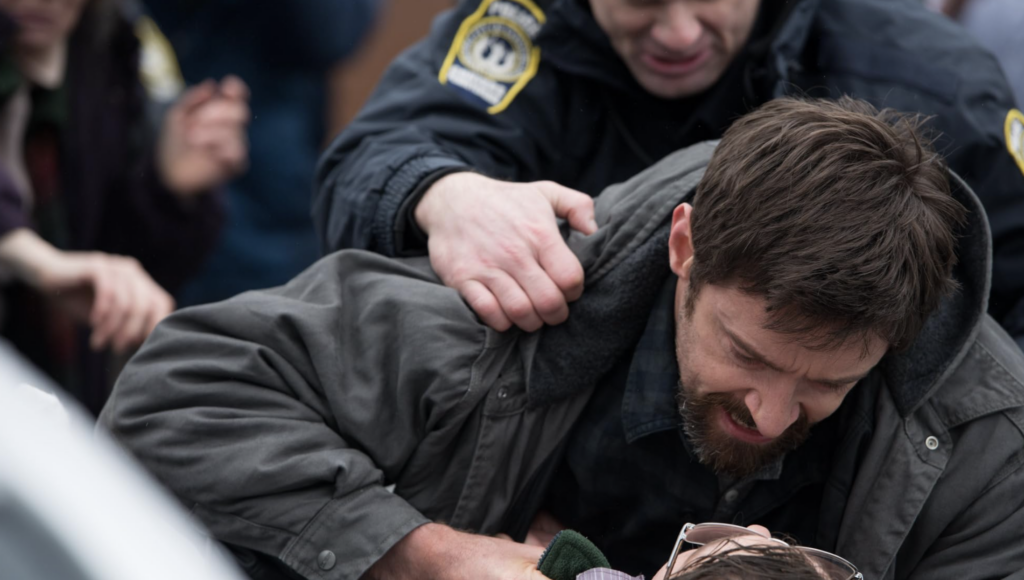
In a Christian film, Keller would burst into desperate prayer, like Jonah inside the whale finally calling on the God never mentioned in Prisoners. There’s nothing wrong with this aspirational type of ending. As I mentioned in my intro to this series, there are at any moment Christians who need this reminder to humble and prostrate themselves. And don’t we all hope for redemption—real redemption that provides the peace that surpasses all understanding? Peace we may get, but what we may not get is healing, the disposal of our earthly woes, or release from the physical prisons of our own making.
But unlike what happens in the average Christian film, there will be no happy ending for Keller. He will have to pay for his transgressions. If Loki the pagan rescues him, he has years of guilt and incarceration ahead of him. If not, he faces a torturous death by dehydration. But if he cries “Lord! Lord!” with all his heart and all his soul, even if he is not rescued he will be released from his prison. That should be a happy enough ending for all of us. But we are all Keller and Holly, at war with God and trapped in a labyrinth of our own design.
