I wrote the Holy Ghost haunts no one like the 20th century English writer. If that’s the case, then it’s apt to say the Fall of Man lives rent-free in the mind of the 19th century French author. Having lived through the Revolution, the Reign of Terror, Napoleon, the Bourbon Restoration, and countless smaller turmoils (one of which forms the backdrop of Les Misérables), I can’t imagine the corrupt, blood-stained canvases Alexandre Dumas and Victor Hugo began with. What they ended up with were two of the most triumphant, exciting, moving, and enduring novels of the Western canon.
The French Revolution sought liberté, égalité, and fraternité, but they also sought the destruction of God. Along with the monarchy, the Church, too, needed to go. Considering how entangled one was with the other, it was not an unreasonable request, except that along with the Church in France, they sought to undo le Dieu himself. The Bible says Creation took seven days? Then the week shall have ten! Unlike the American Declaration of Independence which rooted our equality in a Creator, Danton, Robespierre, Marat, et al, felt Man could arbitrate virtue just fine, thank you.
Dumas and Hugo saw the results and disagreed. Their stories are undergirded with the divine dignity of all human beings, conferred upon them by a merciful, loving, and sometimes maddening God. While many worthy movie versions exist, I’ll focus on the 2002 imagining of Count directed by Kevin Reynolds and the 2012 musical film of Les Misérables from Tom Hooper. Both are top-flight films, and both ably convey the Christian themes of the books, even though neither is a “Christian” production.
Hold on, you say. The Count of Monte Cristo director Reynolds also helmed the reverent Risen and it stars James Caviezel, Jesus himself! True, but Risen was 14 years off and Caviezel was still a few mainstream films away from The Passion of the Christ. Whatever gospel influence that movie has comes straight from Dumas’ epic novel.
And what themes are those? Isn’t this a revenge story? Revenge—that’s an interesting word. We use it as a synonym for vengeance, but the two words have slightly different shades. Vengeance, rightfully pursued, is justice, not the exacting of hurt for hurt.
Dearly beloved, avenge not yourselves, but rather give place unto wrath; for it is written, “Vengeance is mine; I will repay, saith the Lord.” — Romans 12:19
I really like the King James Version of this verse, where St. Paul gives the proper place for wrath: it belongs alone to God, for only His justice is just. Man’s can never be. This corrupted justice is embodied in Villefort, the magistrate who is on the verge of setting our hero Edmond Dantes (Caviezel) free, until he sees doing so could imperil his own family. At that point, the judge condemns the innocent Dantes to the Château d’If, an offshore prison from where none return. Poor Dantes, ripped away from his beloved father and his fiancée Mercédès! Imprisoned for 15 years, Dantes never learns why he’s there, until he and his fellow inmate Abbé Faria (one of Richard Harris’s last roles) reason it out. It’s at that point the sailor and the priest conspire to escape. Only Dantes succeeds, wrapped in the late Abbé’s burial shroud.
And so we have the condition of Fallen Humankind in prose. Each of us can be capable, strong, young, and successful, as Edmond Dantes was. But it’s of no benefit to us. We are each imprisoned—on Earth by jealous rivals such as Danglars and Fernand Mondego (played by a quietly seething Guy Pearce) and in eternity by our own fallenness. Only death frees us.

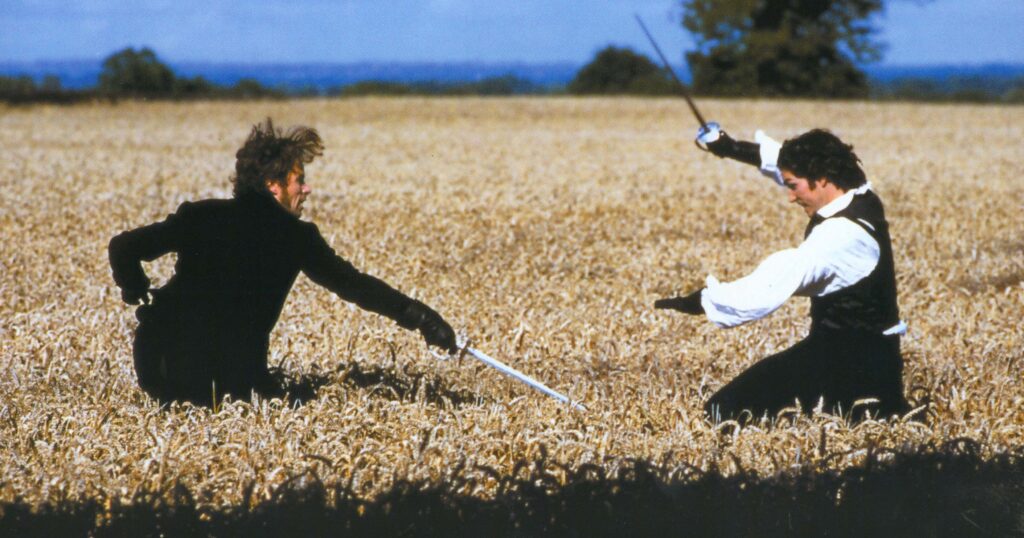
After Dantes’ “death,” he travels to the Isle of Monte Cristo (Mountain of Christ in English) where Abbé Faria had amassed a large hidden treasure. He uses this treasure to become the mysterious Count and re-enter Paris society and exact his revenge. In the end, he cannot bring himself to kill any of his enemies. Rather, he reveals Danglars and Villefort for the scoundrels they are and allows Mondego to leave, but without his wife Mercédès (who married Mondego after hearing Dantes had died), his son Albert, and his fortune. Dantes takes those in retribution—Mercédès still loves Dantes and has tired of Mondego’s affairs and Albert (Henry Cavill in an early role) learns Dantes is his real father. In the best scene of the movie, Mondego turns his horse around and declares, “I couldn’t live in a world where you have everything and I have nothing!” And so Fernand Mondego’s pride and envy seal his fate, as well as setting the stage for one banger of a sword fight.
The movie ends with the inscription Abbé Faria encouraged Dantes to scrawl on his prison wall: God will give me justice. And so God shall give each of us justice. Vengeance is His and His alone, we must wait on him, die, and be reborn on the Mountain of Christ. Dumas goes one better. He ends his book:
All human wisdom is contained in these two words: Wait and Hope.
Hope in Christ. Wait for the Resurrection.
If modern American Christians hold Les Misérables in high regard, I don’t hear much of it. Perhaps we fear it glorifies revolution, or at least poorly thought-out rebellion. Maybe it’s too long, too French, or too Catholic. Or maybe we don’t enjoy musical theatre as much as we should. Certainly the popularity of this story stands firmly on the musical’s shoulders.
And in Tom Hooper’s film adaptation, we get a knockout performance from Hugh Jackman as Jean Valjean:
After Valjean is convicted by the mercy of the bishop, he confesses his sins, repents, and literally tears up his parole papers. He is free from his life as a sinner!
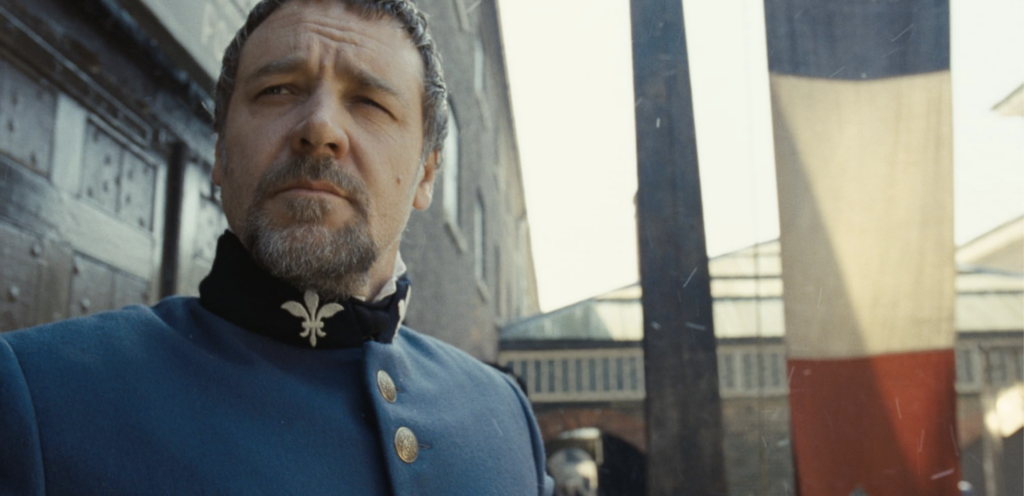
It’s too bad Inspector Javert (Russell Crowe) didn’t get the memo. Javert is revenge—man’s revenge, not God’s vengeance. In 21st century America, he might be the guy who thinks we should lock people under the jail and lose the key. But even unmovable policemen can be moved, as Javert eventually is. Unfortunately, his unyielding legalism is also his undoing.
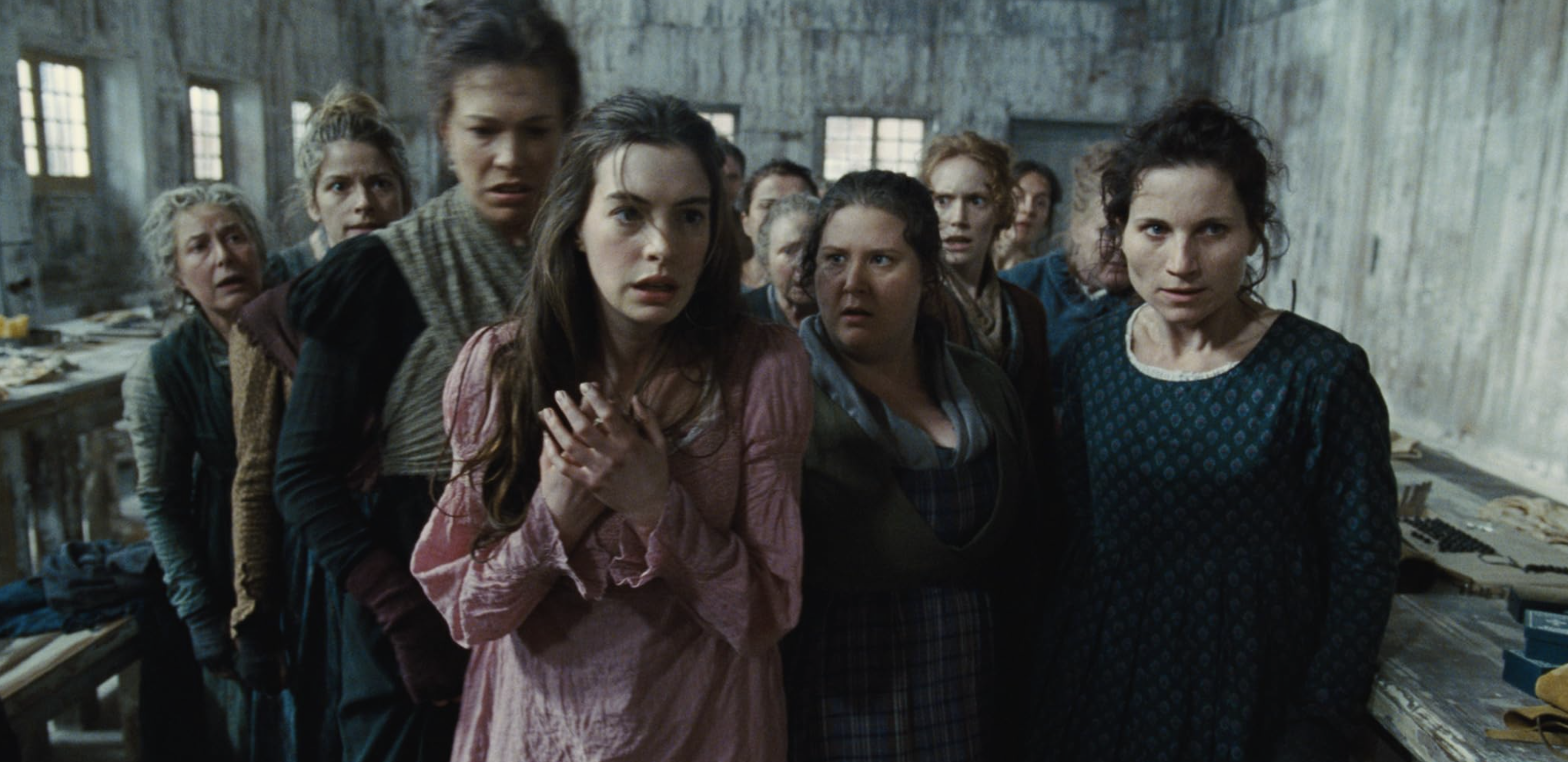
I think this film adaptation does an excellent turn for Fantine, played and sung admirably by Anne Hathaway. Here we have a woman, a single mother, poor and unloved, who must literally sell her body parts to survive. For most of human history, this disdain for the poor has been the norm. It is not what God wills. When He vents his wrath on his people Israel, when He sends the prophets to warn them of the whirlwind to come, high among his list of gripes is their lack of regard for the widow and the orphan. Hugo, too, was moved by the poor, les misérables, around him. Like The Count of Monte Cristo, this is a story about justice—God’s justice. Even though the revolutionaries led by Marius and Enjolras (played by Eddie Redmayne and a very charismatic Aaron Tveit) are portrayed as heralds of righteousness, their objection to Louis-Phillipe is pure background noise. Paris endured so many uprisings between 1789 and the Second Empire, most of us lose track of when Les Misérables takes place.
And so we find ourselves back at the beginning. Christ’s mercy, in both films/books conveyed by priests, changes Edmond Dantes and Jean Valjean for the better. The rejection of mercy impels Fernand Mondego and Javert to their disquieting ends. And so justice is accomplished—not by the hand of Man, but by God.
Both of these movies were big releases and box office hits becoming of their source material. Neither Dumas nor Hugo set out to write hand-wringing sermons on mercy and justice. Dumas at least was paid by the word, stretching The Count of Monte Cristo out to its epic length. It’s a masterpiece of intrigue that holds up well in all the adaptations I’ve seen, especially in the excellent miniseries directed by Bille August. This eight-part show starring Sam Claflin as Dantes and Jeremy Irons as Abbé Faria spends less time on action and more on the Count’s intricate machinations, making it more faithful to the book. The 1998 non-musical film of Les Misérables (also directed by August) should have been better. The A-list cast and filmmakers did a fine job realizing the broad outlines of the story. But it lacked the scale and soaring emotions of the 2012 musical film. Both stories deserve the sweeping Hollywood treatment of these film adaptations. Among the locations, action, and performances, we also got timeless reminders of how God offers the downtrodden dignity, the unjustly accused mercy, and for all of us, terrible and comforting justice.
