In my intro to this series, I posited that the Christian movie industry exists in part to give American Christians something they don’t often get from Hollywood: the dignity of being taken seriously. Movies like Shape of Water and Citizen Ruth paint churchgoing Christians as brainwashed hypocrites. They have ulterior motives for attending church, reading the Bible, and praying. They do these things to exploit others or because they’re ignorant—certainly not because they believe in God. We get repressed puritans (Carrie), controlling patriarchs (Inherit the Wind), and abusive clergy (The Apostle, Elmer Gantry).
And then there is the new Netflix movie Wake Up, Dead Man, the third Benoit Blanc mystery. I went into this film hearing it was, like the aforementioned films, critical of the Church and Christianity. It’s anything but. What it is critical of is the corrupting influence of culture, power, and the personality cults that surround charismatic clergy. (One other thing, too, which I’ll get to in a bit.) But the one thing I absolutely loved about this film is it takes Christ, Christianity, and the Church very seriously. That makes this a serious (and seriously fun) film.
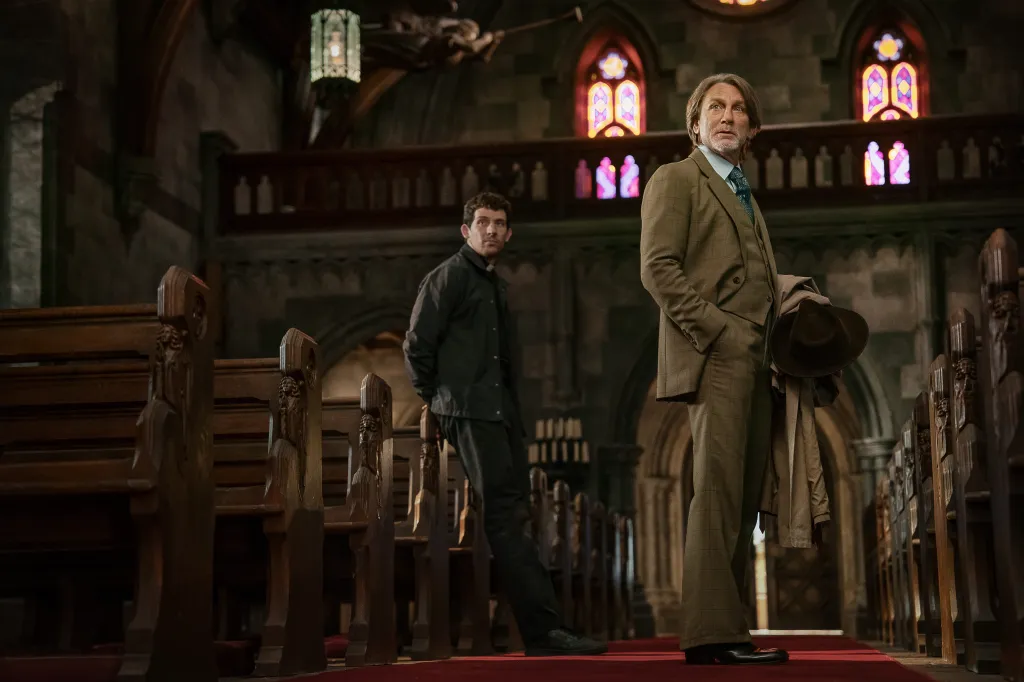
Josh O’Connor plays Father Jud Duplenticy, a former prizefighter who killed an opponent in the ring. He plays out his repentance as an earnest priest assigned to a small church under the thumb of Monsignor Wicks (Josh Brolin). Wicks dies in front of his small flock, the victim of a “locked room” mystery, and it’s up to Blanc and Fr. Jud to solve the mystery.
The first half of the movie is narrated by Father Jud. Wicks was a hateful, angry priest at war with the world. Citing everything from climate change to DEI to queer activism, Wicks wanted to fight, in contrast to Jud who wants to preach reconciliation through Christ. At first, we seem to be set up for a contest between a caricatured firebreather and a mealy-mouthed capitulator. Far from it. Father Jud is the real deal.
A lot of movies want to use the language of the Bible without understanding what it means. Wake Up, Dead Man knows its Bible. It gets some of the mechanisms of Catholic rites wrong (it really shouldn’t have—those are incredibly easy fixes), but the spirit is there. When the Benoit Blanc calls out scripture for being mere storytelling, Father Jud answers:
You’re right. It’s storytelling. The rites and the rituals. Costumes, all of it. It’s storytelling. I guess the question is, do these stories convince us of a lie? Or do they resonate with something deep inside us that’s profoundly true, that we can’t express any other way except storytelling?
Writer-director Rian Johnson may not be a practicing Christian, but this response is profoundly insightful. Yes, God gives us his Word through Law and in the person of Jesus Christ. And Jesus tells stories to explain the law and also the Gospel. What else are parables? The annals of Kings and Chronicles? Why tell the story of Ruth, who but for her offspring is a nobody? Because in her story is the story of God’s redemption. She comforts her miserable mother-in-law and Yahweh plucks them both from misery, elevating them and ennobling them. God is unknowable. The Great Story makes Him known to those who hear his Word.
Another key scene: Father Jud and Blanc are on the verge of a discovery when the priest calls a contractor who may have a key clue. At first he is frustrated with her chattiness. But then she asks for counsel—Louise is estranged from her sick mother and doesn’t know what to do. Father Jud slows down, leaves the room, and closes the door. Many minutes pass, and Blanc finally opens the door to find the priest praying with Louise over the phone. It’s a real prayer, too, scripted and acted as if the filmmakers know how to pray. The most basic duty and pleasure of a believer has rarely been so honestly portrayed. Even in the wonderful Dead Man Walking, Susan Sarandon’s bathroom prayer is all agony and no peace—it’s as if this nun never quieted her soul and kneeled in supplication and petition before her Lord.
This prayer, spurred by a minor character (a detail I absolutely love), solidifies Father Jud’s vocation and purpose. It even drives him to confess what he thinks is his crime. And that in turn drives the self-professed heretic Benoit Blanc to a genuine Road to Damascus moment, offering grace to another character. This is not a cheap and easy grace. It is real, as a true and devoted Christian understands it.
A few other points. In Wake Up, Dead Man, all the priests swear and call people names. In my experience, that’s not true to life; I suspect the filmmakers were wary of making a “clean” film and being confused with the Kendrick Brothers. Second, Wake Up, Dead Man is the best of the Knives Out movies. The mystery is solid, and Rian Johnson throws out several clever red herrings aimed at the Agatha Christie devotee.
And then there is that other thing I mentioned. Where Knives Out contained swipes at white privilege and Glass Onion lampooned billionaires like Elon Musk and Mark Zuckerberg, Wake Up, Dead Man goes straight for the top. If you don’t see Donald Trump in Monsignor Wicks, you’re not paying attention. One of the characters (a rising Republican politician) latches onto Wicks and even creates a cartoon of him modeled on Trump’s NFT images. Andrew Scott plays a sci-fi author devoted to Wicks’ exhortation to “fight” the culture. Jeremy Renner plays a cuckolded doctor who likes Wicks’ muscular theology. There are other ways to interpret Wicks’ cult of personality, to be sure. Many churches have pastors who command such loyalty, the church becomes more about them rather than Christ. I also see an unsettling “fortress mentality” among some Christians fearful (justifiably in some cases) of worldly ideas infecting their families. Scott’s sci-fi author builds a comical moat around his house, to which he has attached a sign labeling it a FORTRESS. If that isn’t a clear indictment of this anti-evangelistic sentiment, I don’t know what is.
But in the end, Wicks is an antichrist—not Satan, but one who holds himself up in place of Christ. Vote and cheer for Trump’s policies all you want, but if you look to him to save you or America, you make him an antichrist. This is why some Christian and conservative critics decried this movie. They have it all wrong. You cannot worship both God and Man, whether it’s a charismatic pastor or president. The godly man does fight, but for the Gospel, for forgiveness, for the full knowledge of Jesus Christ. He is humble, repentant, and points to the cross, only the cross. Father Jud in a key scene replaces a broken crucifix with one he fashions with his own hands, echoing Jesus the carpenter. The final shot ends with a sly reference to the Pearl of Great Price, for which the wise person sells everything he has to possess. This Pearl is the Kingdom of Heaven, which Jesus described in a parable. Because He loves a great story.
My family and I all agreed the story of Wake Up, Dead Man really belonged in an American evangelical church. However, Catholic churches are more beautiful, more sacred-feeling. The rite of absolution plays a critical role, and the sun streaming through the Gothic windows provides a storytelling element in two pivotal scenes. This works better than the Jumbotrons and vari-lights that characterize most nondenominational churches, which is more an indictment on modern church design than anything else. We Protestants preach conserving the past, so why don’t we want to conserve sacred architecture? So Catholicism it is, and with it an earnest and sincere depiction of an earnest, sincere priest surrounded by sinful, fallen people. That includes the priest himself and even Benoit Blanc, the “rational” detective who criticizes the Church for racism, misogyny, and homophobia. That even he comes to realize his sinful, fallen state is the best recommendation I can give for this movie.
