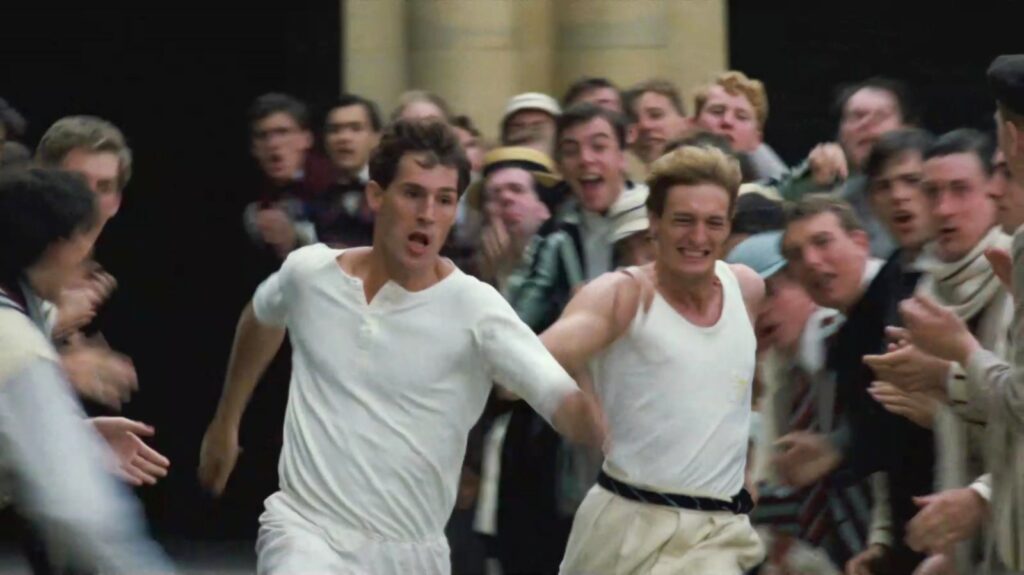
I’m going to kick things off with Chariots of Fire. The reason is simple. This film not only clearly demonstrates a muscular, unwavering faith, it also stands at a crossroads in time. The years after 1981, when Chariots of Fire opened, have been referred to as the “post-Christian age.” Before 1981, Christianity in the U.S. and U.K. would have been “the norm.” There was no need for a Christian movie industry because every movie had at its foundation Christianity, Judaism, or some admixture of the two—the “Judeo-Christian values” so often touted today. Major studios and talents made The Ten Commandments, Ben-Hur, The Robe, and The Greatest Story Ever Told because the Bible was warp and woof of life in the West. Moviegoers flocked to see these films—they were rip-roaring entertainments and artistic masterpieces first and sermons second, if at all. Of course, you had the occasional Inherit the Wind critical of Christianity and the Church. But for the most part, America was, as many on the Right aver, a “Christian nation.”
Not that Hollywood was lousy with Christians. Between the solid Jewish foundings of the movie business and the Communist, activist, and socialist leanings of creatives in general, it would be an error to describe most filmmakers as Christian. Even conservative stalwarts like John Wayne suffered through multiple marriages and divorces, plus other peccadillos that were hardly exemplary. (More on that in another article—I could argue the best “Christian” films have been made by nonbelievers.) Nevertheless, Christianity and its worldview were the default setting, and it was into this changing world that Chariots of Fire exploded on the scene.
How did this movie ever get the applause it deserved? It’s a period piece set in the 1920s, about a devout Christian and a Jew with a huge chip on his shoulder. It also follows a sympathetic aristocrat and an even more sympathetic English diva who falls in love with the Jew. A gentile portrayed the Jew. A gay actor played the Christian. The movie was produced by a Muslim and a socialist and is beloved by Christian movie fans today, even as many of us don’t hew to Eric Liddell’s ultra-strict view of Sabbath observance. It has an unconventional structure. About the only thing this film is universally lauded for is its Vangelis music score. Indeed, the theme music has become a metonymy for running and athletic striving in general. Vangelis won one of four Oscars bestowed on this classic, including one for Best Picture.
That’s not all correct, though. It is lauded because it’s a great movie. It’s affecting, inspiring, and uplifting. It has many things to say about motives, about faith, about convictions, about personal honor. If there are any faults, it’s the characters—Eric Liddell is almost too saintly. Lord Lindsay is too unsnobbish. Aubrey Montague is too bland. Harold Abrahams, the most relatable of the bunch, seems bedeviled by the most minor of foibles. But all these people existed. By most accounts, Liddell was really this convicted. Chariots of Fire could only exist because it’s about real people and real events.
And so this movie endures due to its obsession with Truth. So let’s get the historical inaccuracies out of the way. Harold Abrahams never attempted the Great Court Run at Cambridge—Lord Lindsay’s inspiration did, but producer David Puttnam (the aforementioned socialist) added Abrahams’ participation for better equity. Eric Liddell knew well in advance the 100-meter Olympic event would take place on Sunday. Jennie Liddell did not object to Eric’s racing. These last two events were played up in the movie to add dramatic tension. I propose that these scenes of license add nothing to Eric’s Christian convictions. The 100-meter was Eric’s sweet spot—to train up to the 400-meter rather than run on the Lord’s Day is testament to his conviction. And Eric’s apologia to Jennie is one modern Christians recite today:
“I believe God made me for a purpose, but he also made me fast. And when I run I feel his pleasure.”
There is the essence of vocation, the Christian ideal of purpose. Why did God make you? Contra Jennie, the believer’s purpose is not only the ministry of church work, but the ministry of excellence. What are you good at? God put you on earth to do that. Because He values excellence.
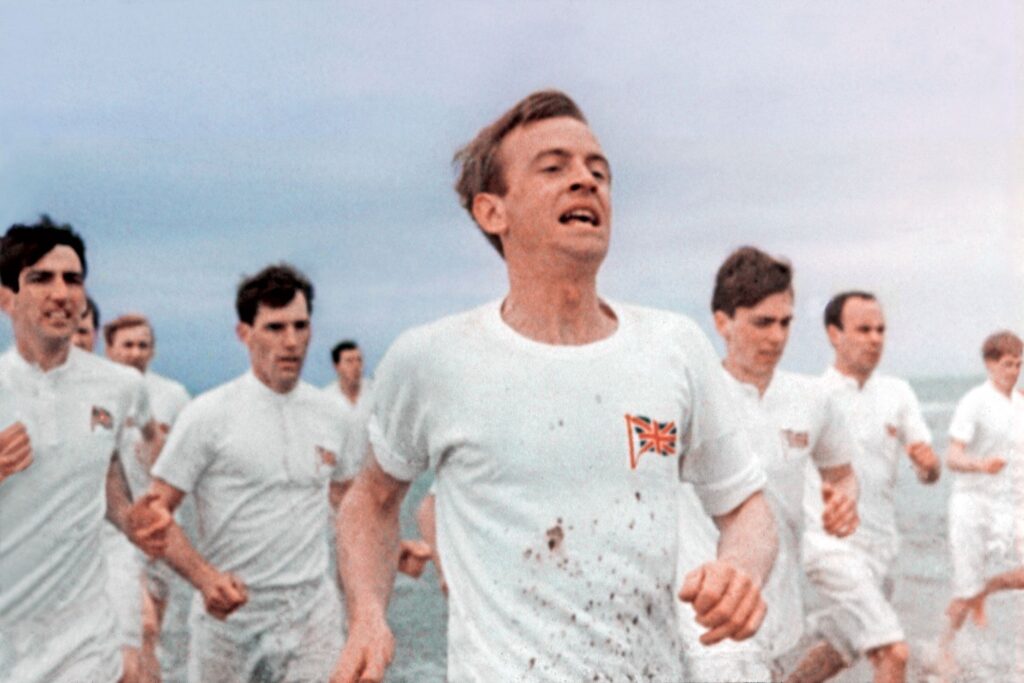
The actor Ian Charleson is so excellent in this role, he becomes Eric Liddell. When he preaches, when he runs, you feel Eric Liddell’s pleasure, and therefore God’s. That this young actor, whose bright career would be cut short by AIDS, testifies to Christ so ably, it reminds one there is no task too in-credible for God.
Another truth told: the bookend scenes that take place at Harold Abrahams’ funeral—a Church of England funeral. That’s right—Abrahams the Jew, who is depicted as struggling with antisemitism at every turn, ultimately married a gentile and converted to Christianity. Could this movie even be made today, and with the non-Jewish Ben Cross (also excellent in his role) playing the tortured Jewish athlete? Probably not—the bookends would need to go, and mention of Abrahams’ conversion would need to be scrubbed. Which would be a shame because Abrahams’ story is a direct foil to Liddell’s.
Liddell is a model of conviction. Even though Charleson is first billed and even though 21st century Christians claim this movie, it doesn’t work without Cross and Abrahams. Not because Abrahams is Jewish, but because he runs for reasons different from Liddell. Eric Liddell runs to please God and bask in His pleasure. Abrahams runs to hit back at the anti-Jewish sentiment he sees lurking around every corner. He runs for revenge and is the lesser for it. The most powerful scene is one of the only he shares with Liddell, where the Scottish Christian defeats him in an early race. Abrahams mopes in the stands, obsessing over his defeat. The clacking of the seats being folded sounds like the rifle shots of a firing squad. He won’t be comforted, not by his admirer Sybil, not by anyone. Only when he finally wins his medal will he be soothed. Not so Liddell—he already has his reward.
Abrahams’ motivations are made even more ironic by the acceptance he receives—from Lord Lindsay, from the Gilbert & Sullivan society he joins, from Sybil Gordon, the beautiful opera star he courts. Abrahams is more English than most of his classmates. The antisemitism he perceives is, let’s be honest, a little overblown. When the Cambridge masters reprove him for hiring a professional trainer, he assumes it’s because he’s Jewish. But the masters do have a point, and it’s Abrahams who is breaking with convention here. On Harold’s first date with Sibyl, he again airs his grievances with the way he’s treated, but then the two share a laugh when the special of the day (a roast pig) is brought to the table.
Do these scenes diminish the very real antisemitism British society harbored at the time? Perhaps—and perhaps another movie can be made about this persistent prejudice. The fact Abrahams feels more put down than he is informs his character. He really is running to prove a point and score political wins. That’s why he hires Sam Mussabini to coach him to victory. Abrahams’ feelings are writ large when he tells Sybil, “If I can’t win, I won’t run!” (Sybil’s counterpoint is even better: “If you won’t run, you can’t win!”) Contrast this to the happy warrior ethos of Eric Liddell.
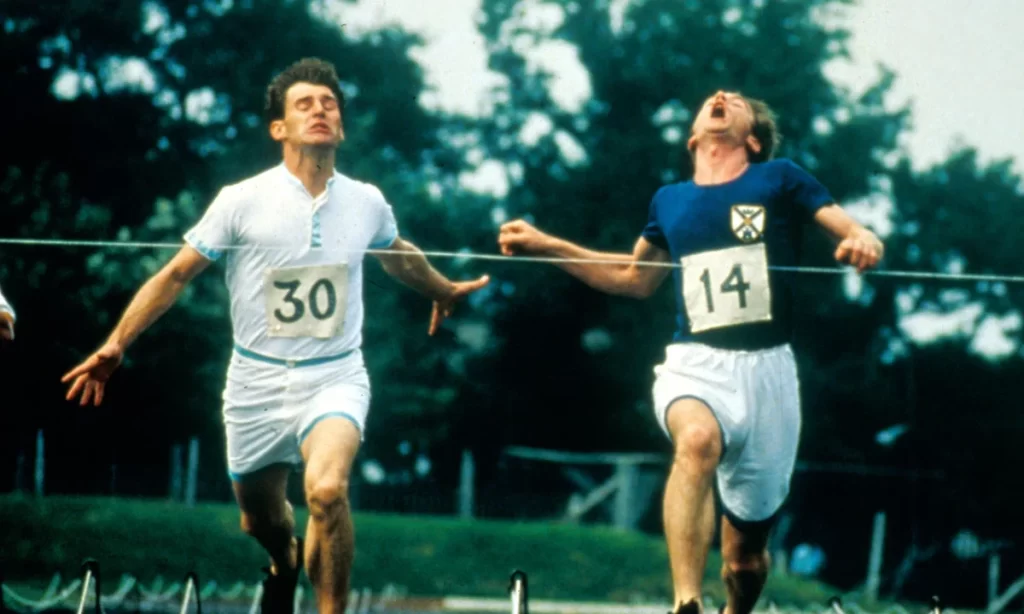
A little about the filmmaking. Vangelis’ music is stirring and highly unconventional for a period piece. Jarring synthesizer music plays over training montages. But the expressive warm sounds create a spiritual mood for the film. Likewise, DP David Watkin and director Hugh Hudson use slow motion sparingly. The opening scenes of the men running on the beach are actually undercranked, creating a choppy, fast-motion feel. The editing of the final victories struck me the wrong way on first watch. Why did the two top-billed actors barely share screen time? Where was the build-up to the Big Game? Only on second watch (this is a movie to be watched over and over!) did I realize Chariots of Fire is not meant to be a conventional sports movie. Yes, it culminates with the 1924 Paris Olympics. But this is not the pinnacle. That already happened when the Prince of Wales tried to pressure Liddell to run on Sunday and the Scotsman refused. I was also struck by the low-key nature of the ’24 Olympics—the runners had to bring their own trowels to dig starting blocks for themselves. Abrahams and Liddell, along with Montague and Lindsay, would get no endorsement deals, no shoes named in their honor. They were not running for the cathartic breaking of the tape. They were doing it for the excellence. Eric Liddell was not even running for king and country—only for God.
And there is the end of the matter, as Ecclesiastes says. Abrahams could barely manage a fist pump after his win. His comfort was in Sybil’s love and acceptance, not his revenge. Eric Liddell also did not revel in victory. He had the utmost confidence he was doing God’s will. Moreover, he was excelling in God’s gifts. As his father the missionary said in the movie:
“You can praise God by peeling a spud if you peel it to perfection. Don’t compromise. Compromise is a language of the devil. Run in God’s name, and let the world stand back and in wonder.“
Oh, that every Christian would praise God in the everyday. And in doing so feel God’s pleasure.
