The Holy Ghost haunts no one like the 20th century English writer. This robust literary tradition has given us J. R. R. Tolkein (Catholic), Evelyn Waugh (even more Catholic), Graham Greene (self-described “Catholic agnostic “), E. M. Forster (irreligious), Philip Pullman (atheist), and C. S. Lewis (atheist-turned-Anglican). Even among the nonbelievers, a streak of Christian theology and language runs through their work, even when the writer is purposely working against it. Of course, this list of great writers would not be complete without P. D. James, an Anglican who, like every sincere Christian, struggles with faith, God, and His purpose for us.
The writers I listed each have one or more work on my “favorite books” list. For Dame James, that book is The Children of Men. Alfonso Cuaron’s film adaptation lacks much of the spiritual depth of the novel. But the story is so infused with Christ, no amount of gunfire or bloodshed can mask it.
The movie starts in the far-distant year of 2027. The human race has been infertile for two decades, and the last child born has died in a senseless bar brawl. England is a grey police state. Refugees pour into the country despite large-scale detention in prison camps. Gangs and radical groups stage violent attacks—in the opening scene, a bomb destroys the café our hero just left. A cloak of despair hangs over London.
Our hero, Theo, is contacted by his ex-wife Julian. She wants him to use his government connections to get a young woman out of the country. He soon learns the woman is pregnant, the first fertile womb in over twenty years. The journey is fraught with violence perpetrated by government thugs, gangs, and presumed allies. Along the way, the mother Kee gives birth and humanity is saved.
This retelling of the Nativity is marked for all the world to see. Theo, the Joseph character, is short for Theodore, “gift of God.” There is a Mary in their group—the midwife is named Miriam. Luke, the treacherous leader of “The Fishes” radicals, is namesake of the Gospel writer who told the Christmas story. In the book, Luke is a priest. In the movie, his Christian fervor is replaced by a lust for power.
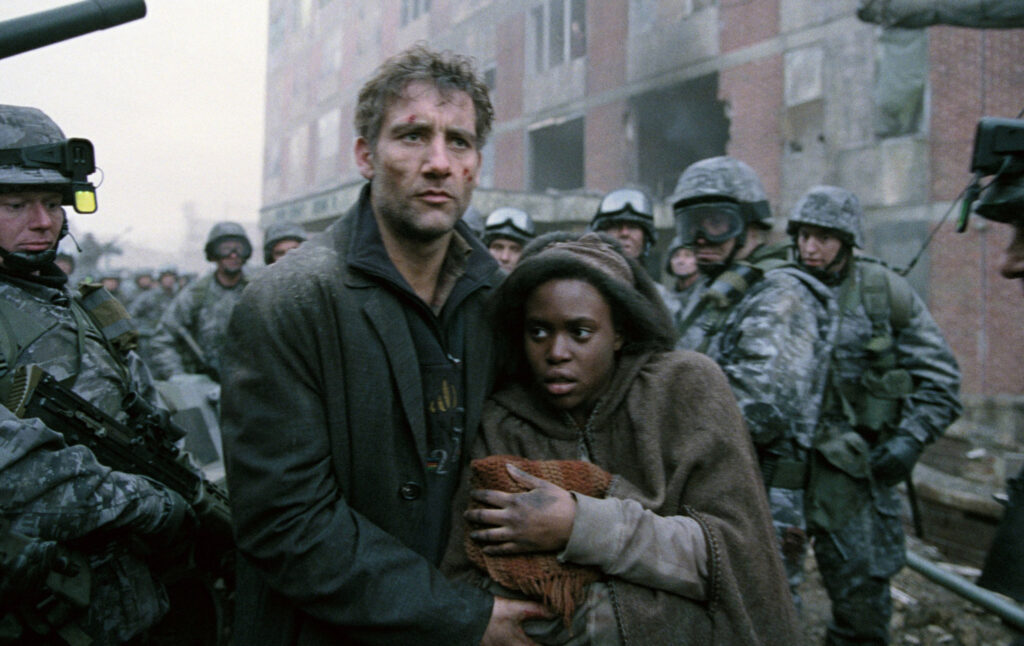
There are other deliberately Christian elements in James’s novel that are muted in the film, but one crucial scene remains. A brutal siege in a bombed-out housing complex ends when the combatants hear the wailing of Kee’s child. Considering the age of the soldiers, this may be the first infant cry they’ve ever heard. The guns fall silent. The fighters lower their rifles. Theo and Kee walk out, and the hardened belligerents marvel at the baby in their arms, for a moment gripped by awe and hope. Then a grenade explodes and everyone goes back to killing.
That scene is one of two astounding long takes. Aside from the riveting and tense story, the film Children of Men is best known for its innovate “oners.” At one point during Theo’s rescue of Kee, fake blood spatters the lens. Cuaron decided to use that take. I harbor a skepticism of long takes because in the age of gimbals and digital cameras, they become a showpiece rather than a storytelling device. (Even Hitchcock confessed that Rope was a fun but failed experiment.) In both the battle scene and the ambush scene where Julian is killed, the long take is not a gimmick. Cuaron uses the long takes to build tension. We see trouble coming as the characters see them. We follow Theo and Kee as they struggle to wind their way out of danger.
Children of Men is both burdened and bolstered by parallels to current events.* Despite what some may say, Mary and Joseph were not mistreated refugees turned away by xenophobic innkeepers. (Joseph’s family was from Bethlehem, and the inn was more likely a relative’s guest house.) But England—indeed, the whole of the West—is at a tipping point. Human rights are eroded every day, unchecked migration has stirred nativist backlashes, and we’re on the verge of a demographic winter.
Why? In the book and movie, there is no explanation. The answer to our current situation is a rumbling hopelessness. Young people fret about climate change, jobs, and buying power, yes, but they also worry about the radical change that children bring. Your life is reordered and re-prioritized. The mother’s body is completely at the service of this growing human. If we are to claw ourselves back from childlessness, there must be hope.
For the Christian, Jesus is that hope, the hope of renewal, of Tomorrow (as the ship that carries Kee and her baby away is so named). The hope of Christ lives in nonbelievers to be sure, and if we are to avoid the world of Children of Men, it should culminate with parents remembering and reminding the young why they love children, how their laughter and trials and unpredictable growth bring joy, wonder, and hope.
In James’s novel, the baby is actually Theo’s and Julian’s. In the movie, their baby son died in a global pandemic (another eerie prediction). Kee names her newborn Dylan in his honor. I wonder if this was a reference to Dylan Thomas, another great British writer of the 20th century. As Theo bleeds out from his wound, does he rage against the dying of the light? I prefer to think of Thomas’s other famous poem, “And death shall have no dominion.” The refrain comes from Romans 6:9:
Knowing that Christ being raised from the dead dieth no more; death hath no more dominion over him.
St. Paul wrote it is Christ over whom death has no dominion. But in his resurrection, we will all be raised, and the human race shall never die.
*Children of Men the movie came out in 2006. The novel was published in 1992. That they saw these events coming makes James and Cuaron even more visionary.
